
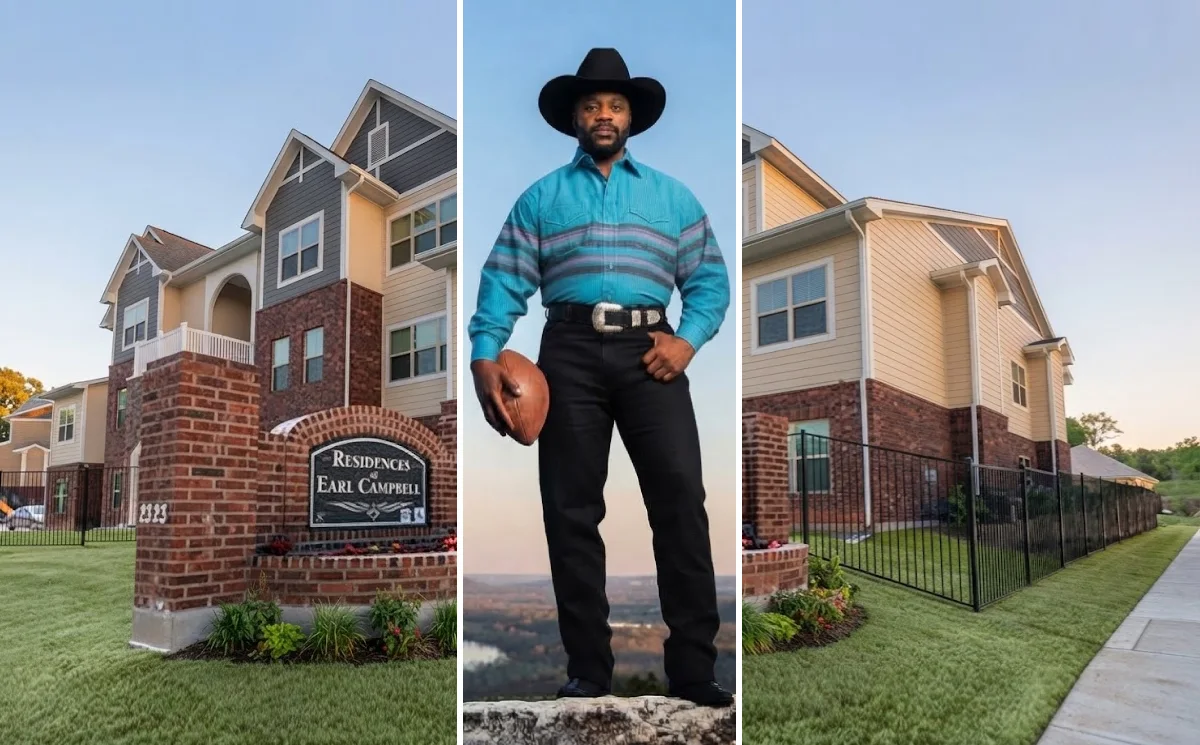
Search for the Earl Campbell house and the first results are for an apartment community in Tyler, Texas called The Residences at Earl Campbell. It is named in his honour, it is affordable housing, and he does not live in it. That confusion is worth clearing up at the start, because it is the single most common error in results for this name.
His actual property record is very thin, and that is itself informative. Campbell grew up as one of eleven children in a small house on a rose farm in Swan, just north of Tyler, won the Heisman Trophy and was the first pick in the NFL draft, and has spent his later life in Austin. The one house he is documented paying for is the one he built for his mother; no purchase, sale, price or listing for a home of his own appears in any reliable source.
This guide covers what is genuinely established, and what the two Texas cities in his life actually represent.
Who is Earl Campbell?
Earl Campbell is an American former football running back, born in Tyler, Texas in March 1955 and known throughout his career as the Tyler Rose. He won the Heisman Trophy at the University of Texas in 1977, was selected first overall in the 1978 NFL draft by the Houston Oilers, was named NFL Most Valuable Player in 1979, and took Offensive Player of the Year three years running from 1978.
Before that he led John Tyler High School to the 1973 state championship and played for Darrell Royal at Texas. In Houston his coach was Bum Phillips, the face of the Oilers’ “Luv Ya Blue” era, and when Phillips moved to the New Orleans Saints, Campbell followed him in a 1984 trade and played his last season there in 1985. A nine-foot bronze statue of him was unveiled at the university’s stadium in 2006.
He was inducted into the College Football Hall of Fame in 1990 and the Pro Football Hall of Fame in 1991, and was named to the NFL’s 100th Anniversary All-Time Team in 2019. The Earl Campbell Tyler Rose Award, given annually to a leading offensive player in college football, carries his name.
Away from football he founded Earl Campbell Meat Products in 1990, producing smoked sausage and barbecue sauce, and opened a barbecue restaurant on Sixth Street in Austin in 1999, which closed in 2001. He has also served as a special assistant to the University of Texas football programme.
He married Reuna Smith, his girlfriend from the eighth grade, and they have two sons, Christian and Tyler.
The house he grew up in
Campbell was one of eleven children. His father died when Earl was eleven, and his mother, Ann, raised the family on a small rose-growing operation in Swan, just north of Tyler, in circumstances that were, by every account including his own, genuinely poor.
The house from that period has been photographed and circulated many times, usually alongside the observation that he was still connected to it in the late 1970s when he was winning the Heisman Trophy and being drafted first overall. It is a small, plain East Texas house, and the distance between it and what he achieved is the reason it keeps being published.
The money changed the property, though not in the way most rookies spend it. After signing with the Oilers in 1978, Campbell paid for a new, larger house for his mother and had it built about 25 feet from the old one, so close that, as Sports Illustrated noted in 1979, little more than a septic tank stood between them.
Two houses, 25 feet apart
The family house
Small and plain, on Ann Campbell’s rose farm, where she raised eleven children.
The house he built for her
Paid for out of his first NFL contract and put up right beside the old one.
Neither house is a museum, neither is open to visitors, and there is no reporting on who owns them today. Anyone travelling to Tyler expecting a heritage site should know that no such attraction exists.
The development that carries his name
The Residences at Earl Campbell is an apartment community in Tyler. It is affordable housing, listed on the relevant housing-assistance directories, and it is named for him as a local figure of standing rather than owned or occupied by him.
Naming affordable housing after a man who grew up poor in the same city, and who became its most famous son, is a deliberate and reasonable choice. It is also the reason his name appears at the top of property searches in a way that has nothing to do with where he lives.
Where does Earl Campbell live now?
Austin, Texas.
The evidence is circumstantial but consistent. His business interests have been based in Austin since 1990, his restaurant was there, and his continuing role with the University of Texas football programme requires him to be in the city. Coverage of him routinely describes him as an Austin resident.
Beyond the city, nothing is documented. No purchase record, price, listing or property description exists for him in Austin or anywhere else. Some sites give a bedroom and bathroom count for an Austin house attributed to him; those come from property-database matching rather than from any reported transaction, and they should be treated as unverified.
Tyler and Austin, side by side
- Connection
- Born there; grew up on the farm in Swan
- Carries his name
- An affordable housing community
- Property on record
- The house he built for his mother, 1978
- Lives there now
- No
- Connection
- College career; business base since 1990
- Carries his name
- A bronze statue at the university stadium (2006)
- Property on record
- None documented
- Lives there now
- Yes, by every account
There is also a practical dimension worth stating plainly, because it is relevant to housing. Campbell has lived for many years with the physical consequences of his playing career, including severe arthritis, nerve damage causing foot drop, and spinal stenosis diagnosed in 2009, and has used a cane or a wheelchair. A person in that position chooses a house for accessibility rather than for display, which is one straightforward reason a Hall of Fame running back might live somewhere no property reporter has ever written about.
Why there is no property trail
Campbell played in a very different financial era. He entered the NFL in 1978 and retired in 1985, before the salary explosion that made later running backs wealthy for life. He was the best player in the league at his position and was paid accordingly for the time, which was a fraction of what a comparable player earns today.
From Swan to Austin
- 1955Born in Tyler, one of eleven children
- 1973State title with John Tyler High School
- 1977Heisman Trophy at Texas
- 1978First overall pick by Houston; builds his mother a new house in Swan
- 1984Traded to New Orleans
- 1985Final NFL season
- 1990Starts his meat products company in Austin
- 1991Pro Football Hall of Fame
- 2009Diagnosed with spinal stenosis
That, combined with a business career built on sausage and barbecue rather than on investment, and years of significant medical need, produces a housing history that never generated a headline. It is the opposite trajectory to the one documented for players of later generations, whose purchases are covered as news; compare the accounts of Michael Vick’s rise from public housing and Randy Moss’s properties, both of whom played long after the money changed.
The honest summary is that Earl Campbell grew up in a small house in Tyler, lives in Austin, and has never owned a home that anyone has publicly documented. The building in Tyler that bears his name houses other people.
Sources
- Wikipedia for his upbringing in Tyler, family circumstances, career record, business ventures and health, cross-checked against Pro Football Hall of Fame records.
- Sports Illustrated (September 1979) on the farm in Swan and the house he built for his mother beside the old one.
- University of Texas Athletics for his Heisman year and continuing association with the programme.
- Affordable Housing Online for The Residences at Earl Campbell in Tyler, confirming it as an affordable housing community named after him.
- The Earl Campbell Tyler Rose Award for the award established in his name.
