
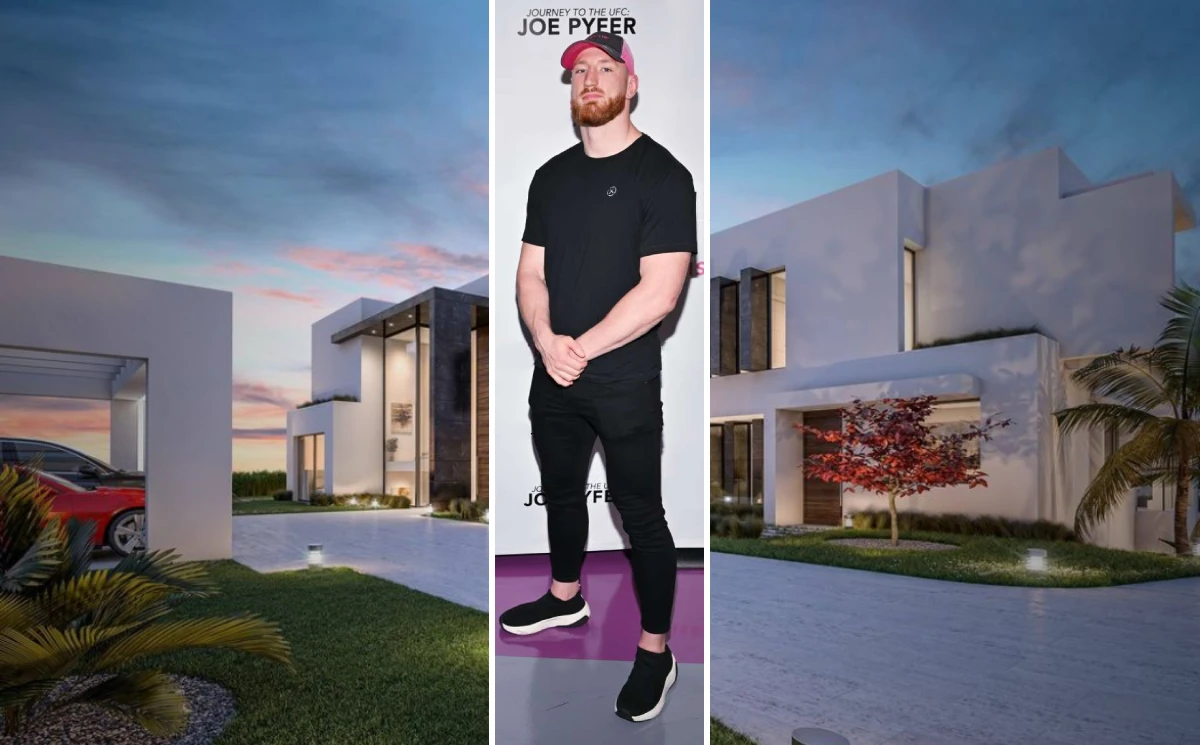
Before Joe Pyfer became one of the biggest names in the UFC middleweight division, he was a fighter with nowhere to sleep. The story of how Dana White stepped in to keep him housed after a single knockout on Dana White’s Contender Series is one of the most searched moments in recent MMA history — not because it involves wealth or celebrity, but because of how close it came to not happening at all.
Why People Search “Joe Pyfer House”
The search term “Joe Pyfer house” points to one specific, documented event: Dana White paid Joe Pyfer’s rent for a year after Pyfer revealed, right after earning his UFC contract, that he was on the verge of becoming homeless.
That detail landed hard because of where it happened. Pyfer had just knocked out Ozzy Diaz in front of White, screaming “Thank you for the opportunity!” with tears in his eyes. Minutes later, off camera, he told White he had nowhere to live. White’s response was immediate.
“Joe Pyfer, when I left the press conference that night, he told me he was about to be homeless. So — that ain’t gonna happen,” White told reporters at a later press conference.
No fanfare. No press release. White disclosed it weeks later, almost reluctantly, when a reporter asked him directly.
What Actually Happened After the Contender Series Win
Pyfer was the lone fighter to earn a UFC contract on Dana White’s Contender Series Season 6 (also referred to as DWCS 47) in the summer of 2022. He told White he had nowhere to live, and White gave him enough money to cover a year’s worth of rent.
Pyfer confirmed this publicly himself after his UFC debut win over Alen Amedovski at UFC Fight Night 210. He specifically asked UFC matchmaker Sean Shelby if he could speak with White after that fight — not to talk rankings or contracts, but to say thank you.
“I told Shelby I need to talk to him, because I need to thank him, because he gave me a home for a year,” Pyfer said. “He gave me money on the side of Contender. And, really, that secured me being able to have a place to live for the next year, on the house of Dana.”
That phrase — “on the house of Dana” — is where the “Joe Pyfer house” search largely originates: a fighter publicly crediting the UFC president for keeping a roof over his head.
The Childhood That Made This Moment Necessary
To understand why Pyfer was in that position, you have to go back well before 2022.
Pyfer’s early years were shaped by an abusive household. His father beat him physically and verbally from the time he was very young. Pyfer was 16 when his father nearly choked him to death — the moment that finally pushed him to run.
He spent roughly a week sleeping on a bench at Barrall Park in Media, Pennsylvania, walking miles after school and ducking into Wawa stores just to stay warm.
That stretch — a teenager sleeping on a park bench — shaped almost everything that came after. It’s also where his nickname “Bodybagz” originated: kids mocked him for the dark bags under his eyes, a physical byproduct of the stress and lack of sleep he was living with. He later turned the name into part of his fighting identity instead of running from it.
He found stability through one teacher. Will Harmon, a teacher and assistant wrestling coach at Penncrest High School, became one of the most important figures in Pyfer’s life. Pyfer spent lunch periods in Harmon’s classroom, played chess, listened to music, and got the kind of steady adult presence he hadn’t had before. Pyfer later said, “Without him, I would have never made it to the UFC.”
The Road to the Contender Series — Including the Broken Elbow
Pyfer didn’t walk onto DWCS and knock someone out on his first try. He’d been there once before, in 2020, and it went badly.
His first shot on Dana White’s Contender Series came in August 2020, and it ended brutally when his bout with Dustin Stoltzfus was stopped after a slam led to a severe elbow injury. It was the kind of setback that can end momentum entirely, and it kept him sidelined for well over a year.
During that layoff, Pyfer dealt with depression before slowly rebuilding.
His comeback fight was a one-punch knockout at Cage Fury FC. That earned him a second shot on DWCS in July 2022, and this time he made it count.
After a night of fights that had left White visibly frustrated, Pyfer delivered the highlight of the evening against Ozzy Diaz, knocking him out in Round 2. An emotional Pyfer screamed at White, “Thank you for the opportunity!” — one of the most memorable moments of that season.
White’s on-air reaction became the famous “Be Joe Pyfer” speech. What followed privately, off camera, was the rent money that changed Pyfer’s immediate future.
What Dana White Actually Said — and Why He Said It
White didn’t volunteer the housing story. He was asked about it at a later press conference and gave a notably understated answer.
“I do a lot of things for a lot of people that I don’t necessarily talk about,” White said. “Joe Pyfer, when I left the press conference that night, he told me he was about to be homeless. So, that ain’t gonna happen.”
He also confirmed it wasn’t the first time he’d quietly helped a fighter this way — just the first time it became public. The disclosure came from Pyfer, not from White.
What Happened Next: The UFC Career
Once his housing situation stabilized, Pyfer went to work.
- UFC debut (September 2022): First-round TKO over Alen Amedovski at UFC Fight Night 210.
- UFC 287 (April 2023): TKO win over Gerald Meerschaert, earning Performance of the Night.
- UFC Fight Night (October 2023): Technical submission win over Abdul Razak Alhassan, his second Performance of the Night.
- UFC Fight Night (February 2024): Lost by unanimous decision to Jack Hermansson — his first UFC defeat.
- UFC 303 (June 2024): Rebounded with a first-round knockout of Marc-André Barriault, earning another Performance of the Night award.
- UFC 320 (October 2025): Won via submission against Abusupiyan Magomedov in Round 2.
- UFC Fight Night, Seattle (March 28, 2026): Stopped two-time former UFC Middleweight Champion Israel Adesanya via TKO in Round 2 of the main event, earning a $100,000 Performance of the Night bonus.
Pyfer entered that Adesanya fight ranked 14th in the middleweight division. He jumped eight spots afterward, and as of the rankings update on March 31, 2026, he sits at No. 6 in the UFC middleweight rankings — his fourth straight win, three of them finishes.
Where Does Joe Pyfer Live Now?
Today, Joe Pyfer is no longer bouncing between temporary homes or sleeping on park benches. The UFC middleweight contender currently resides in Las Vegas, Nevada — the fight capital of the world.
After Dana White’s financial support gave him a stable foundation, Pyfer made the strategic move to Las Vegas to be at the heart of the sport. He now trains full-time at Xtreme Couture, one of the most prestigious MMA gyms in the world, alongside other elite UFC veterans. Living in Las Vegas allows him constant access to the UFC Performance Institute, world-class sparring partners, and the ability to stay fight-ready year-round.
While the exact street address of his home remains private (as it should be), Pyfer has firmly planted his roots in Nevada. The move from a park bench in Pennsylvania to a permanent residence in Las Vegas symbolizes the full-circle moment of his incredible journey — from homeless teenager to top-six UFC middleweight, stable, focused, and finally at home.
The Punch Power Record Nobody Talks About Enough
One detail about Pyfer that often gets buried under the rest of his story is the raw physical tool behind it all: his punching power.
Despite giving up roughly 85 pounds to Francis Ngannou, Pyfer reportedly broke Ngannou’s punching power record at the UFC Performance Institute in Las Vegas. [VERIFY: exact figures need a live source check — this stat circulates widely but isn’t consistently sourced to an official UFC PI record release]
Whatever the precise number, it lines up with what shows up on tape. Nine of Pyfer’s wins have come by knockout, and that power is the physical explanation behind almost every finish on his record.
What the “Joe Pyfer House” Story Actually Means
Strip away the MMA context, and here’s what the story really is:
- A teenager escapes an abusive home at 16 and sleeps on a park bench.
- He finds one mentor who keeps him stable enough to pursue fighting.
- He shatters his elbow on the biggest stage of his career and battles depression during a year-plus layoff.
- He claws his way back, earns one shot, takes it — and in the same breath as signing a UFC contract, admits he has nowhere to live.
- His new employer quietly pays his rent for a year, with no announcement.
The house isn’t really a house. It’s a year of breathing room that kept a career on track when it easily could have derailed.
Pyfer’s own framing of it says as much: “I think the guy gets shit on a lot for not being a good dude… but as far as how he’s treated me, he’s treated me gracefully. He’s my boss, and I want to like him, I want to respect him, and I have all the respect in the world for him.”
Conclusion
The “Joe Pyfer house” story is real, documented, and told largely in Pyfer’s own words. Dana White paid a year’s worth of rent for a newly signed fighter who, hours after earning his UFC contract, had no place to sleep. That act didn’t just keep Pyfer housed — it kept the conditions stable enough for him to train, compete, and eventually crack the top six of the UFC middleweight rankings.
The fighter who once slept on a park bench in Pennsylvania now knocks out former two-time champions in UFC main events. The house was the bridge between those two realities — and by the sound of it, Pyfer hasn’t forgotten it.
