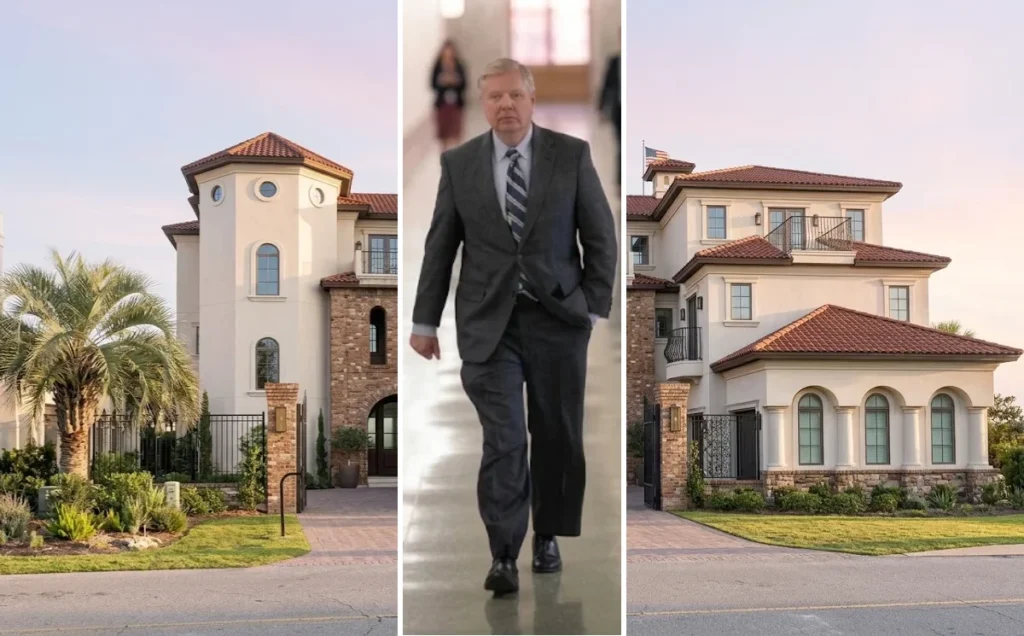
For more than three decades, Lindsey Graham split his life between two homes: a modest three-bedroom house in Seneca, South Carolina, that he bought for $164,000 in 1993, and a Capitol Hill townhome in Washington, D.C. The South Carolina senator died on July 11, 2026, at age 71, after what his office called a “brief and sudden illness.” His real estate record is unusually plain for someone who spent 30 years in Congress, and that plainness is the story.
$164,000
Bought 1993Seneca, SCThree bedrooms
Purchase price of his Seneca home, according to Oconee County property records cited by the SC Daily Gazette.
The Lindsey Graham House in Seneca, South Carolina
Graham bought the Seneca house in 1993, the year after he won a seat in the South Carolina House of Representatives and two years before he went to Congress. The SC Daily Gazette, reviewing his finances after his death, reported that he paid $164,000 for it according to Oconee County property records, and that “when home,” he still lived in the same three-bedroom house.
No listing, floor plan or interior photos of the property have been published, and the outlets that covered his finances did not give a square footage. What is on record is the purchase price, the bedroom count and the fact that he never traded up, even as he became one of the best-known Republicans in Washington.
Seneca is a small city in Oconee County, near Lake Keowee and a short drive from Clemson. It was also where his younger sister, Darline, moved to live with relatives after their parents died. Friends interviewed by WLOS in July 2026 described him as a neighbor who kept coming back: his childhood friend Ted Durham, a Seneca barber, said Graham still stopped by for haircuts and conversation. Seneca Mayor Ronnie O’Kelley put it simply: “He didn’t forget where he came from.”
The house drew national attention on July 4, 2024, when the Party for Socialism and Liberation held a pro-Palestinian protest outside it over his support for Israel. Graham responded with a statement backing the right to peaceful protest and apologizing to his neighbors for the disruption.
The Capitol Hill Townhome
When Graham arrived in Washington as a freshman congressman in 1995, he bought a half share in a Capitol Hill townhome with Van Hilleary, a Republican congressman from Tennessee who came in with the same class. According to Graham’s former spokesman Kevin Bishop, quoted by the SC Daily Gazette, Graham bought out Hilleary’s share after Hilleary left the House around his 2002 run for governor of Tennessee. No purchase price for the townhome has been reported.
His Senate financial disclosures list one liability: a mortgage with Rocket Mortgage in Washington, D.C., taken out in 2012 and valued between $100,001 and $250,000. Disclosures use broad ranges, and the filing does not name the property, so it cannot be tied to the townhome with certainty.
The Washington home was also a protest site. In September 2020, activists gathered outside it at night, banging pots and pans, after Graham said he would move forward with confirming President Trump’s Supreme Court nominee before that year’s election.
Reports said emergency crews responded to a cardiac arrest call at his Capitol Hill home on the night of Saturday, July 11, 2026, a day after he returned from a trip to Kyiv. Bloomberg Government reported that the D.C. medical examiner’s preliminary finding was an aortic dissection.
Seneca vs Capitol Hill
Seneca, SC
$164K
Bought 1993
- Three bedrooms
- His South Carolina base for 33 years
- Site of a July 2024 protest
Capitol Hill, D.C.
Price not reported
Half share bought 1995
- Co-owned with Rep. Van Hilleary
- Graham later bought him out
- Where crews responded on July 11, 2026
Growing Up Behind the Sanitary Cafe in Central
Graham’s first home was a room behind his family’s business, the Sanitary Cafe, a bar and pool hall on Main Street in Central, South Carolina. NPR’s 2015 profile of his upbringing reported that the family later moved into a trailer, and a law school roommate compared his start in life to Abraham Lincoln’s, minus the log cabin. The house he lived in later in Central has since become Villa Toscana, an Italian restaurant whose menu included a “Senator’s Chicken Parmesan.”
His mother died of Hodgkin’s lymphoma and his father of a heart attack about 15 months apart while he was in college. At 22, he became the legal guardian of his 13-year-old sister so she could receive his Air Force benefits. That background helps explain why a senator with three decades in Washington kept a $164,000 house in his home county rather than a lake house or a beach property.
Lindsey Graham’s homes, in order
- 1950s-60sGrows up in a room behind the Sanitary Cafe in Central, then a family trailer
- 1993Buys a three-bedroom house in Seneca $164,000
- 1995Buys a half share of a Capitol Hill townhome with Rep. Van Hilleary
- Early 2000sBuys out Hilleary’s share of the townhome
- 2012Takes out a Washington, D.C. mortgage, listed at $100,001 to $250,000
- July 2026Dies at 71 after a sudden illness; crews were called to his Capitol Hill home
What Net-Worth Sites Get Wrong
Several celebrity net-worth pages list a “primary residence” and other properties for Graham with dollar values attached. None of them cite a deed, a listing or a news report, and they do not match his disclosures. The SC Daily Gazette found no other real estate in his filings: his assets were mutual funds, Treasury securities and bank accounts, and the only luxuries it named were a South Carolina-built BMW X5 and his golf clubs. Map-pin sites that claim to show the Lindsey Graham house rely on user comments, not records, and should not be treated as confirmation of anything beyond the town.
What happens to the homes now
As of the latest reports reviewed for this article, no sale or listing of either the Seneca house or the Capitol Hill townhome had been reported since his death in July 2026.
Sources
- SC Daily Gazette via ABC News 4 (July 2026): Seneca purchase price and year, three bedrooms, Capitol Hill townhome history, mortgage disclosure, other assets.
- NPR via OPB (July 2026): his death at 71 after a brief and sudden illness.
- WLOS (July 2026): Seneca friends and the mayor on his life in the town.
- NPR via KUNC (June 2015): childhood at the Sanitary Cafe in Central, the trailer, Villa Toscana, his parents and sister.
- Yahoo News (July 2024): the July 4, 2024 protest outside his Seneca home.
- KXAN (September 2020): the 2020 protest outside his Washington home.