
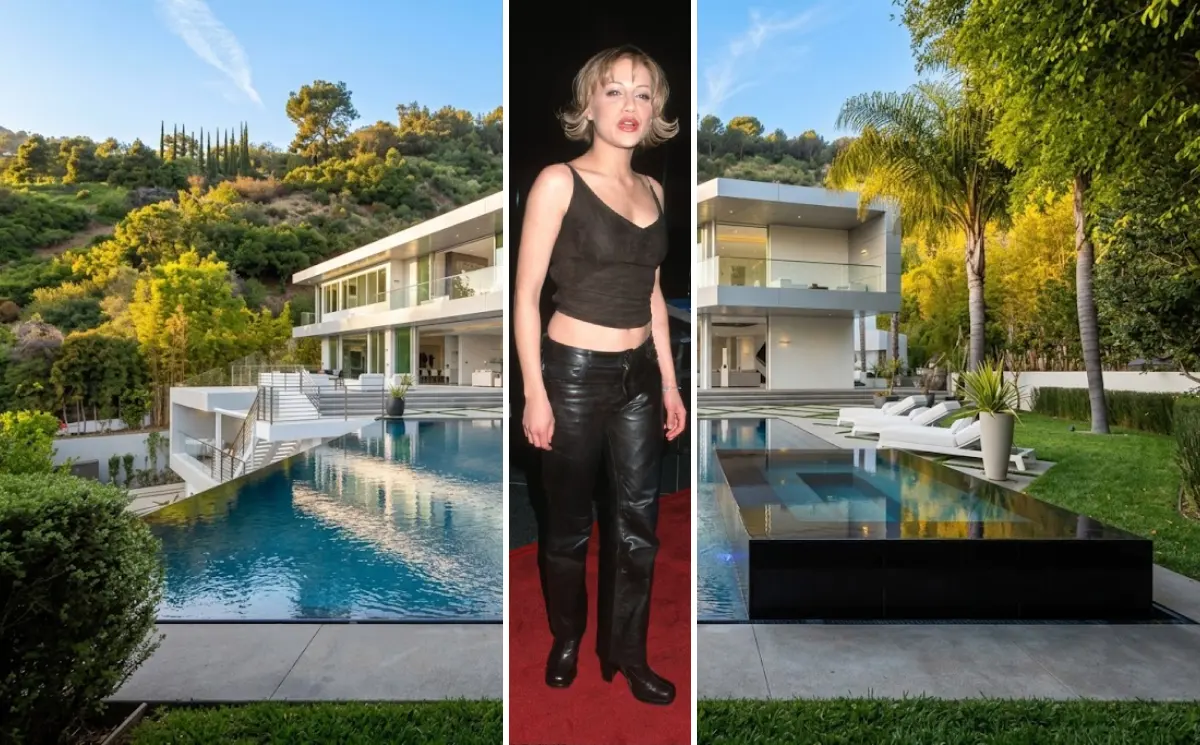
The single most important fact about the Brittany Murphy house is one most articles never mention: it no longer exists. The Hollywood Hills home she bought from Britney Spears in 2003, and where she died in December 2009, was demolished in 2013. The large contemporary mansion that now occupies the site, and that has been listed and relisted at prices between $12 million and $18 million, is a different building entirely.
What follows is the documented chain of ownership and prices, from Murphy’s purchase through her mother’s sale at a substantial loss, the teardown, and the sales that followed. It clearly illustrates how a property’s value can collapse after a tragedy and then recover completely once the original house is gone.
Quick House Facts
| Detail | Original house | Current house |
|---|---|---|
| Location | Rising Glen Road, Hollywood Hills, above the Sunset Strip | |
| Size | ~8,000 sq ft | ~9,400 sq ft |
| Layout | Fully furnished when sold to Murphy | Six bedrooms, 8.5 bathrooms |
| Status | Demolished in 2013 | Currently privately owned |
| Notable prior owner | Madonna, before Britney Spears | |
Who was Brittany Murphy?
Brittany Murphy was an American actress and singer who became widely known for Clueless in 1995 and went on to films including Girl, Interrupted, 8 Mile, and Sin City, alongside long-running voice work as Luanne Platter in King of the Hill. She was 32 when she died.
She died at her Hollywood Hills home on 20 December 2009. The Los Angeles County coroner attributed her death to pneumonia, with iron-deficiency anaemia and multiple drug intoxication listed as contributing factors. Her husband, the screenwriter Simon Monjack, died in the same house in May 2010, and the coroner reached broadly similar conclusions in his case. Those events are the reason the property has been written about continuously for more than fifteen years, and they are treated here only as far as the property record requires.
Murphy’s will, drawn up before she married Monjack, left her estate to her mother, Sharon. That is why Sharon, rather than Monjack, was the one who owned and later sold the Rising Glen house.
The house she bought from Britney Spears
The property sits on Rising Glen Road, in the stretch of winding streets above the Sunset Strip that has housed working actors and musicians for decades. Before it was associated with either Spears or Murphy, it had already passed through at least one other well-known owner: Madonna is reported to have lived there in the years before Spears bought it.
Murphy bought the home in 2003 for $3.85 million, taking on an 8,000-square-foot house that came fully furnished. The seller was Britney Spears, which is an unusual pedigree for a house and part of why it has attracted so much attention since.
Spears has since written about her own uneasy experience of living in the house, describing a sense of bad spirits there. Those remarks come from her memoir and are a personal account rather than a claim about the property, but they have driven a great deal of the coverage and are the reason the listing is routinely framed around hauntings. The house’s actual history is unsettling enough without that framing. Spears’s own later property history took her out of the hills entirely.
Property’s Timeline
- 2003: Brittany Murphy buys the house from Britney Spears for $3.85 million.
- 2009: Murphy dies at the home in December.
- 2010: Her husband, Simon Monjack, dies at the same home in May; the property is put up for sale.
- 2011: Sold by Murphy’s mother, Sharon Murphy, for $2.7 million.
- 2013: The original house is demolished and a new one built.
- 2017: The replacement house sells for $14.53 million.
- 2019: Relisted after standing empty for two years, asking $17.99 million.
- 2020: Sold again in December for $12.2 million.
- 2024: Listed again, priced around $18 million.
The sale after the deaths, at a substantial loss
The property was put up for sale in 2010, initially listed at $4.99 million. It did not find a buyer at anything close to that, and at one stage it faced a foreclosure auction, which was avoided.
It eventually sold in 2011, by Murphy’s mother, Sharon Murphy, for $2.7 million — nearly half the original asking price, and more than $1.1 million below what Murphy had paid eight years earlier, in a Los Angeles market that had otherwise recovered a good deal of its ground since the 2008 downturn.
The discount is the clearest evidence of what agents call stigma. Two deaths in the same house within five months, extensive press coverage, and a persistent public association with tragedy narrow the buyer pool sharply, and the buyers who remain expect to be paid for taking it on. The pattern is not unique. A property strongly identified with a death often either sells fast to a buyer who is untroubled by it, as happened with Gene Hackman’s Santa Fe estate, or sits and sells at a discount, as this one did.
The demolition, and why it matters
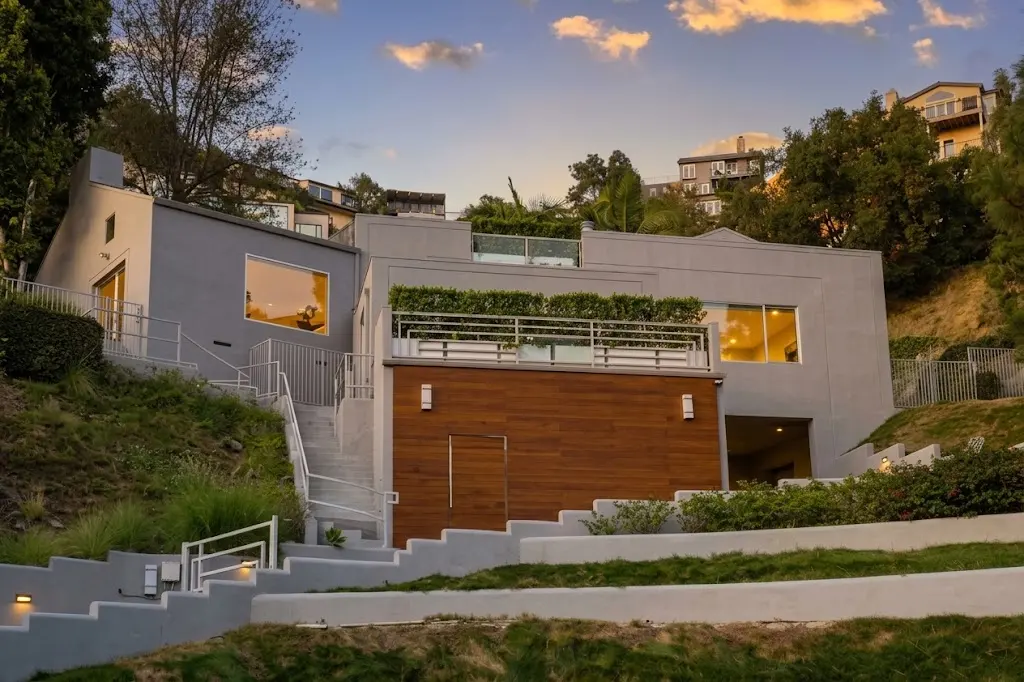
No public record states an official reason for the demolition, but the sequence of events points to a straightforward business decision rather than anything more dramatic. By 2011, the house had already sold at a steep loss and had struggled to attract buyers at any price close to its market value, weighed down by its association with two deaths. For a developer, tearing down a stigmatized structure and building a new one is a standard way to reset a property’s value: buyers pay for the land, the location and the views, not for a specific building, so replacing the house removes the one thing keeping the price depressed.
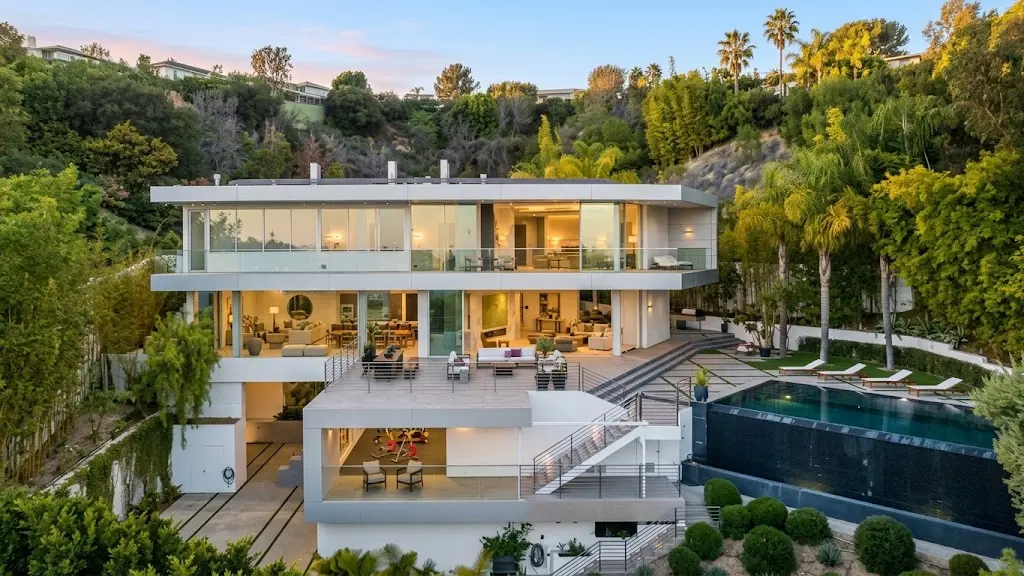
In 2013, the house was torn down. Developers rebuilt on the lot, producing a contemporary mansion of roughly 9,400 square feet — noticeably larger than the 8,000-square-foot house it replaced — with six bedrooms and eight and a half bathrooms, bearing no relationship to the original structure.
This is the point most coverage skips, and it changes how the later prices should be read. The 2017 sale at $14.53 million was not a rehabilitation of the Murphy house’s value. It was the sale of a new, larger, and far more expensive property that happens to sit on the same land. The site’s location, its views and its lot were always worth a great deal; the building that carried the stigma was removed.
It also means the interiors circulating in listing galleries and in articles about the Brittany Murphy house show rooms she never saw.
What happened to the house, and who owns it now
Because Murphy died in 2009, the usual question of where she lives now does not apply. The relevant question is what became of the property, and the answer is that it has changed hands repeatedly since.
After the 2013 rebuild, it sold for $14.53 million in 2017. Rather than holding its value, it went back on the market in 2019 asking $17.99 million and sat unsold for a year before finally selling in December 2020 for $12.2 million — nearly $6 million under that asking price. In late 2024, it returned to the market at around $18 million, a figure that has since been reported with reductions. According to the listing agency at the time, the current owners had also put a further sum into renovations, reportedly around $2.7 million, on top of the purchase price. The current owners are private individuals with no connection to Murphy, and their identity is not a matter of public interest.
The pattern across those transactions is a property that developers repositioned successfully, but that has traded unevenly, selling below asking price more than once while being marketed well above its last sale price since. Nothing in the recent numbers has anything to do with Murphy. They reflect the top end of the Hollywood Hills market, which has been volatile throughout the period.
Sources
- TV Insider on the 2003 purchase from Britney Spears, the 2011 sale by Sharon Murphy at $2.7 million, and the 2013 demolition and rebuild.
- Resident on the 2017 and 2020 sales and the 2024 listing.
- Fox News on the avoided foreclosure auction during the period the home was for sale.
- People on the home’s prior ownership by Madonna, the original 8,000-square-foot layout, the 2019 relisting, and the rebuilt property’s renovation spend.
