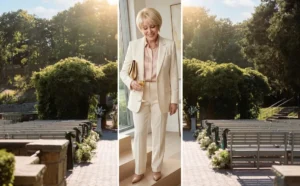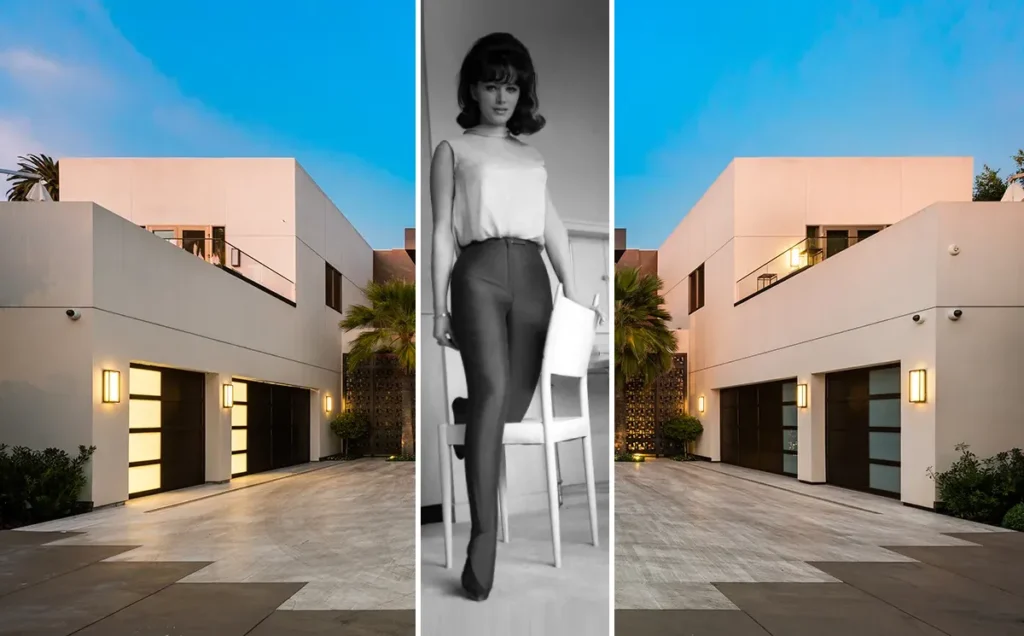
Jackie Collins built her Beverly Hills house and filled it with her own idea of Hollywood glamour, the same idea she sold to hundreds of millions of readers. She died there in September 2015. Her three daughters inherited the estate, listed it in February 2016 at $30 million, and sold it later that year for $21 million.
The buyers then spent five years and around $25 million gutting it. The resulting house, roughly 21,000 square feet with seven bedrooms and fourteen bathrooms, was listed at $66 million.
This guide follows that chain, including the second Collins house next door that Al Pacino had leased for years, and what it says about what happens to a home built around one very specific personality.
The property’s timeline
| Date | Event | Figure |
|---|---|---|
| September 2015 | Jackie Collins dies at the house, aged 77 | — |
| February 2016 | Listed by her three daughters | $30 million |
| 2016 | Sold to Ben and Bita Nehmadi | $21 million |
| Also acquired | Neighbouring house, also owned by the Collins estate, long leased by Al Pacino | $9 million, off-market |
| Around 2016 to 2021 | Gut renovation of the main house | Around $25 million |
| Recent | Main house listed; the neighbouring house listed separately | $66 million, later reported at $59 million; neighbour at $16 million |
Who was Jackie Collins?
Jackie Collins was a British novelist, born in London in 1937 and the younger sister of the actress Joan Collins. She wrote thirty-two novels, every one of which reached the New York Times bestseller list, and sold in the region of 500 million copies worldwide. Her books, among them Hollywood Wives and the Lucky Santangelo series, were built on an insider’s account of Los Angeles wealth and behaviour.
She moved to Los Angeles in the 1980s and stayed. She was diagnosed with breast cancer and kept it private for more than six years, disclosing it shortly before her death in September 2015 at the age of 77.
The relevant point for a property article is that her house was not incidental to her work. She wrote about this world from inside it, and the house was part of the position.
The house she built
Collins had the Beverly Hills mansion built for herself, which is why it is described in the coverage as a house built for a novelist rather than one she happened to buy.
It was, by every account, unrestrained. The interiors reflected her taste rather than a designer’s, and the property functioned as a setting for the kind of entertaining her novels described. That combination, a house made to one person’s specification and then closely identified with them in public, is exactly the thing that makes a property difficult to sell afterwards.
Her daughters listed it in February 2016, five months after her death, at $30 million. It sold within the year for $21 million, some $9 million below the asking price.
The second house, and Al Pacino
There is a detail here that is often left out. The Collins estate also owned a neighbouring house, and it had been leased for years by Al Pacino.
The buyers of the main mansion, the real estate investor Ben Nehmadi and his wife Bita, paid a further $9 million for that property in an off-market deal, consolidating both into one holding. It has since been listed separately at $16 million.
Assembling adjoining parcels in Beverly Hills is a standard investor move, because it creates privacy and optionality that cannot be bought any other way. It also means the Collins estate ultimately released $30 million of property, in two transactions, rather than the $21 million usually quoted.
The renovation that removed her
The Nehmadis then spent five years and around $25 million on a comprehensive gut renovation of the main house.
Consider the arithmetic. They paid $21 million and spent roughly $25 million, a total of about $46 million before the neighbouring property, and the finished house was listed at $66 million, later reported at $59 million.
What that spending bought, in practical terms, was the removal of Jackie Collins from the building. A house strongly stamped with one personality has a narrow market, and the standard response at this level is to strip it back to something a wider set of buyers can imagine themselves in. Forbes described the result as rewriting her legacy, which is a fair reading.
It is the same dynamic documented elsewhere on this site, where a property closely associated with an individual is either demolished or comprehensively reworked before it can trade again, as happened to the house covered in the account of Brittany Murphy’s Los Angeles home.
What happened to the estate
Because Collins died in 2015, the question of where she lives does not apply. What her family did with the property is the relevant question, and the answer is that they sold both houses within about a year of her death.
That was a reasonable decision. A 21,000-square-foot house is expensive to hold, three beneficiaries cannot easily share one, and the estate realised $30 million across the two sales. That the main house has since been marketed at two or three times what they received is a function of $25 million of construction spending and a decade of Beverly Hills appreciation, not of a sale made badly.
The comparison worth drawing is with the estate covered in the account of Joan Rivers’s Manhattan penthouse, where the family sold quickly, and the buyer then spent a decade unable to resell. Collins’s daughters sold to someone who had the money and the intention to rebuild, which is why that property moved on, and the Rivers apartment did not.
Sources
- Robb Report on the $66 million listing, the 2016 sale at $21 million, the five-year renovation costing around $25 million, the $9 million off-market purchase of the neighbouring house and its Al Pacino tenancy.
- Bisnow on the February 2016 listing at $30 million by her daughters.
- Forbes on the renovated estate and its later asking price.
- Carolwood Estates (archived) on the house having been built for Collins and its current specification.