
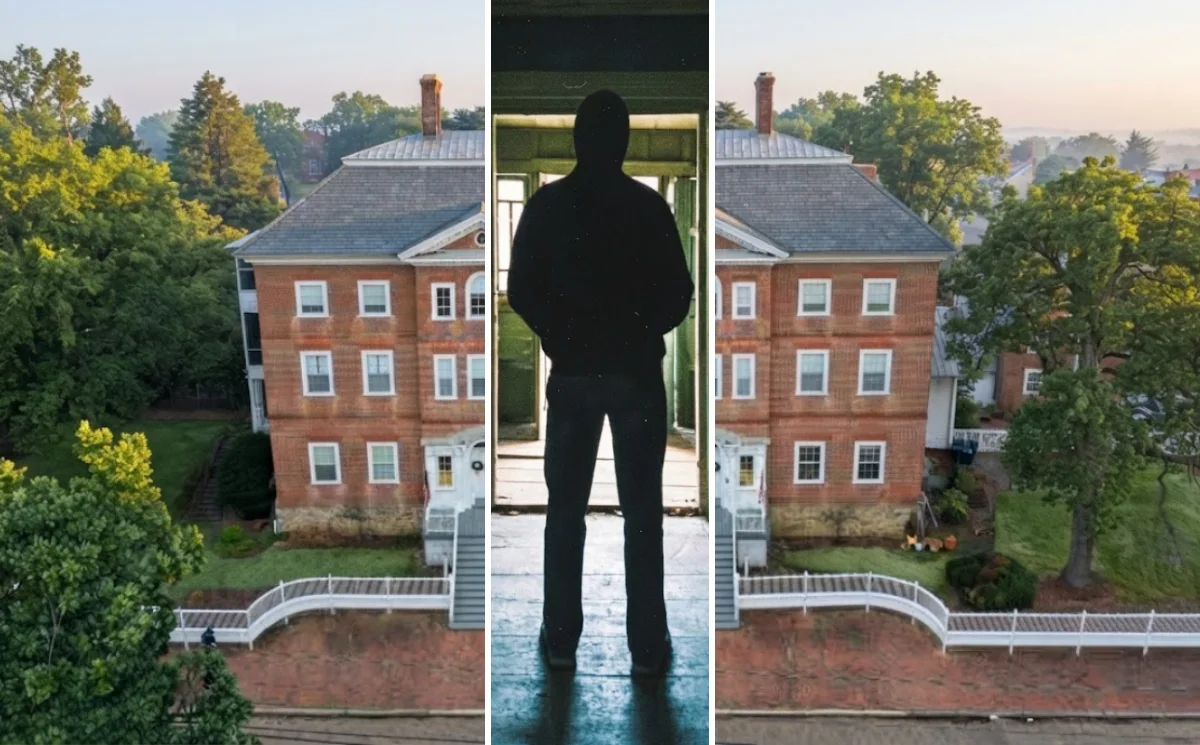
Unlike most subjects covered here, the Chase Lloyd House is not a celebrity’s home. It is a National Historic Landmark in Annapolis, Maryland, built between 1769 and 1774, and one of the first three-storey brick Georgian mansions raised anywhere in the Thirteen Colonies. Its formal name is usually written Chase-Lloyd House, after the two men who built it.
The house has an unusually complete story: a signer of the Declaration of Independence who started it and went broke, a planter who finished it with money made from enslaved labour, one of the finest interiors in colonial America, and a will written in 1886 that turned it into a home for women for well over a century. That last chapter has recently come to an end, and the building’s future is now being decided.
This guide covers all of it.
The Chase Lloyd House at a glance
What is the Chase Lloyd House?
It is a Georgian townhouse mansion in the centre of Annapolis, three storeys of brick, built at the moment when the colonial capital was at its wealthiest and just before the Revolution changed everything. In the early 1770s, Annapolis had an unusual concentration of very rich men building very ambitious houses, and this is among the best.
It was designated a National Historic Landmark on 15 April 1970, the highest level of federal historic recognition in the United States, which is reserved for places of exceptional national significance.
Samuel Chase and the house he could not afford
Construction began in 1769 for Samuel Chase, a lawyer and politician who went on to sign the Declaration of Independence and later served as a justice of the United States Supreme Court.
The house was intended as a demonstration of his wealth and his newly acquired social position, and it is a fairly literal case of overreach. Chase ran out of money before it was finished and sold the unfinished building in 1771. He was, at that point, two years and a great deal of expenditure into a project he could not complete.
That is a more human origin than most landmark houses have, and it is worth remembering when standing in front of it: the man whose name comes first never lived in the finished house.
Edward Lloyd IV, and where the money came from
The buyer was Edward Lloyd IV, a fifth-generation planter from one of the wealthiest families on Maryland’s Eastern Shore. He completed the house in 1774, and it stayed in the Lloyd family until 1847.
The best-known private event in its history came in that period. On 1 January 1802, Lloyd’s daughter, Mary Tayloe Lloyd, married a young lawyer named Francis Scott Key in the parlour. Twelve years later, Key wrote the verses that became The Star-Spangled Banner.
The source of that wealth requires stating plainly. The Lloyd family’s fortune came from plantation agriculture worked by enslaved people. Their principal seat was Wye House, on the Eastern Shore, and the family’s own records document more than five hundred enslaved men, women, and children living there between 1770 and 1834. The enslaved population at Wye House grew from thirty-three in 1770 to 151 by 1834, as the family expanded its operations.
Among the children enslaved on that plantation in the 1820s was Frederick Douglass, who wrote about the Lloyds and about Wye House in his autobiographies. The house he later owned in Washington is covered separately in the guide to Cedar Hill. The connection between the two properties is direct: the money that finished the Annapolis mansion and the system Douglass escaped from are the same thing.
The architecture, and William Buckland
What makes the house nationally significant is chiefly its interior, and the credit belongs largely to William Buckland, the joiner and builder who worked on it.
Buckland had arrived in Virginia as an indentured craftsman and became the most accomplished architectural woodworker in the colonies. His carved wood detailing here, inside and out, is drawn from English Palladian design motifs, executed at a level that had few equals in America at the time. The ornamental plaster ceilings and cornices are attributed to James Barnes and John Rawlings.
Buckland completed the job with the local builder William Noke, and at the same time was working directly across Maryland Avenue on the Hammond-Harwood House for Matthias Hammond. He died in 1774, before that house was finished, so the two buildings facing each other on one street are the last work of his career. Both are now National Historic Landmarks.
Two Buckland houses, one street
Chase Lloyd House
Begun for Samuel Chase in 1769, finished for Edward Lloyd IV in 1774. Three storeys, brick, Georgian.
Hammond-Harwood House
Begun in 1774 for Matthias Hammond and left unfinished at Buckland’s death. Now a house museum.
Annapolis retains an exceptional stock of eighteenth-century buildings, and the city’s later architecture is well represented too, as the account of a modern Annapolis Dutch Colonial on this site shows. The Chase Lloyd House sits at the top of that collection.
A century and a half as a home for women
The house’s second life began with a will. Hester Chase Ridout, the last family owner, died in 1886 having stipulated that the property should serve homeless women, and that if it ceased to do so it would revert to the Episcopal Diocese of Maryland.
That instruction was followed for well over a century. The building operated as a residence for elderly women, run latterly by the nonprofit Chase Home Inc., which is an unusually long and unusually literal fulfilment of a Victorian bequest.
250 years in nine dates
- 1769Samuel Chase begins building
- 1771Chase runs out of money and sells it unfinished to Edward Lloyd IV
- 1774Completed, with interiors by William Buckland
- 1802Mary Tayloe Lloyd marries Francis Scott Key in the parlour
- 1847The Lloyds sell to a relation of Chase
- 1886Hester Chase Ridout dies, leaving it to serve as a home for women
- 15 April 1970Designated a National Historic Landmark
- 2019Survey finds the 1901 portico sinking; the last residents later move out
- NowControl expected to pass to the Episcopal Diocese of Maryland
Can you visit the Chase Lloyd House?
The residential use has ended, and the building’s future is being settled.
A structural survey in 2019 found that a portico added in 1901 was sinking and threatening the wider building. The last six residents moved out, and the executive director of Chase Home, Heather East, has said the extent of the preservation and repair work required means it cannot function as an assisted living centre.
The nonprofit has redirected its work rather than wound up. It now uses an endowment reported at around $7 million to support women through grants to other organisations, eviction-prevention programmes and plans for affordable housing. Because the residential use has stopped, control of the property is expected to pass to the Episcopal Diocese of Maryland under the terms of the 1886 will.
On public access, the organisation’s leadership has committed to keeping the house open to the public, given its architectural importance and its association with Samuel Chase. What that will look like in practice, and on what schedule, has not been fully settled.
Before you travel
Check current access arrangements with Chase Home Inc. before visiting. The residential use has ended, and the handover to the diocese is still being worked out, so opening details published anywhere, including here, may already be out of date.
Sources
- Wikipedia for the construction dates, the Chase and Lloyd ownership, the National Historic Landmark designation, and the house’s later use.
- SAH Archipedia, from the Society of Architectural Historians, on William Buckland’s work and the plasterwork attributed to James Barnes and John Rawlings.
- The Baltimore Banner on the 2019 structural survey, the end of the residential use, the endowment, and the expected transfer to the Episcopal Diocese of Maryland.
- Wikipedia: Francis Scott Key for his marriage to Mary Tayloe Lloyd on 1 January 1802.
- Archaeology in Annapolis, University of Maryland, for the records of people enslaved by the Lloyd family at Wye House.

1 thought on “Chase Lloyd House: The Annapolis Landmark and Its 250-Year Story”