
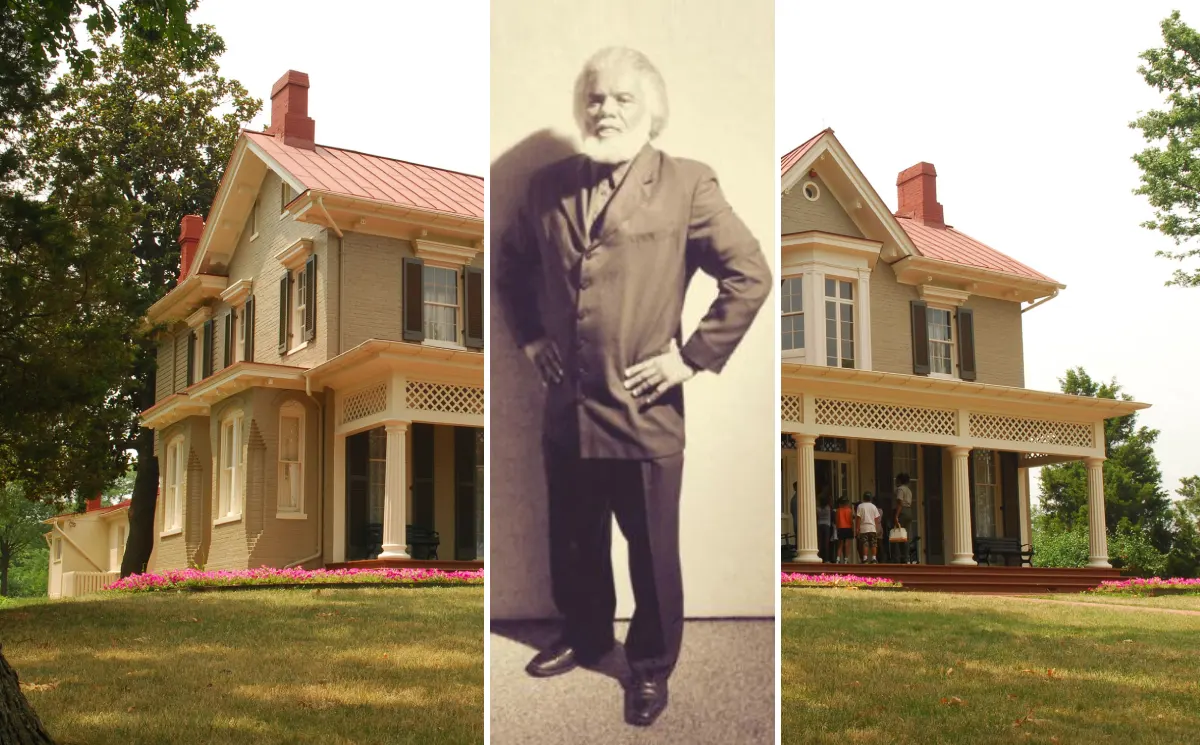
The Frederick Douglass House at Cedar Hill isn’t just another historic property with a plaque out front. It’s the place where one of America’s most consequential voices spent his final 17 years — a hilltop estate in Washington, DC’s Anacostia neighborhood that tells a story far bigger than its 21 rooms.
Frederick Douglass purchased this Victorian home in 1877, just twelve years after the end of the Civil War. That a man born into slavery could own a mansion overlooking the U.S. Capitol wasn’t merely a personal milestone — it was a declaration.
Quick facts:
- Address: 1411 W Street SE, Washington, DC 20020 (~10-minute walk from Anacostia Metro)
- Hours: Tue–Sat, 9:00 AM–5:00 PM (Apr 15–Oct 15); 9:00 AM–4:00 PM (rest of the year)
- Cost: Free — no entrance fee
- House tour: Requires a timed-entry reservation year-round via Recreation.gov; book ahead, slots fill fast
Today, the Frederick Douglass National Historic Site preserves Cedar Hill much as Douglass left it, offering visitors an intimate encounter with the daily life of a figure who reshaped American history.
Frederick Douglass’s Early Life
Frederick Augustus Washington Bailey came into the world around 1818 in Talbot County, Maryland, born into slavery. He never knew his exact birth date — enslavers didn’t bother keeping such records for the people they held in bondage. Separated from his mother in infancy, he rarely saw her before she died when he was seven.
Learning to Read, and Escaping North
His path to freedom began with a dangerous act: learning to read. His enslaver’s wife had started teaching him the alphabet, but her husband quickly put a stop to it, declaring that literacy would make an enslaved person “unfit” to serve. Douglass continued learning in secret, trading bread for reading lessons with white children in Baltimore.
At twenty, Douglass escaped. Disguised as a sailor and carrying borrowed free papers, he boarded a train heading north — the most terrifying stretch of his life. He settled in New Bedford, Massachusetts, married Anna Murray (a free Black woman who helped finance his escape), and adopted the surname “Douglass” to avoid recapture.
Becoming a National Figure
What followed was one of the most extraordinary careers in American history. In 1845, Douglass published his bestselling autobiography, Narrative of the Life of Frederick Douglass, an American Slave. From 1847 to 1851, he ran his own newspaper, The North Star. During the Civil War, he advised President Abraham Lincoln on recruiting Black soldiers.
By 1871, Douglass arrived in Washington, DC, already the most recognized African American in the world. In 1877, he was appointed U.S. Marshal for the District of Columbia — the first Senate-confirmed federal position held by a Black American. He had actually hoped for a different post, such as postmaster in Rochester or ambassador to Haiti, and later felt the marshal role excluded him from ceremonial duties typically expected of the office.
He would go on to serve as Recorder of Deeds for the District and, eventually, as U.S. Minister to Haiti.
Coming to Cedar Hill: The Purchase That Changed History
On September 1, 1877, Douglass purchased Cedar Hill from the Freedmen’s Savings and Trust Company for $6,700 — using a loan arranged with help from his friend, Black abolitionist Robert Purvis. The hilltop property offered sweeping views of the Capitol dome and the Washington Monument, views that must have held particular meaning for a man once considered property himself.
The purchase broke barriers: Cedar Hill was covered by a housing covenant barring Black ownership, and Douglass became one of the first African Americans in Washington to violate such a restriction.
How the Estate Grew
Under Douglass’s ownership, the house expanded from 14 to 21 rooms, with a two-story library wing added around 1886 and a second-story bedroom added between 1892 and 1893. The property itself grew from 9¾ acres to roughly 15 acres after an 1878 land purchase — giving the estate the feel of a gentleman’s farm.
Douglass entertained politicians, activists, and foreign dignitaries at Cedar Hill, and by some accounts played music with his grandson Joseph in the west parlor. He wrote extensively there, including his final autobiography, Life and Times of Frederick Douglass (1881, revised a decade later). For solitude, he retreated to a small stone building called the “Growlery” — named after Dickens — as well as a separate writing studio in the yard.
Family Life and Loss
In 1882, his wife Anna Murray Douglass suffered a stroke and died that August, a devastating loss for Douglass. Two years later, in January 1884, he remarried — to Helen Pitts, a white former clerk and Mount Holyoke graduate who had taught freed Black students in Virginia and Indiana. The marriage drew fierce criticism from both families and the press, but the couple remained together at Cedar Hill for the rest of Douglass’s life.
Douglass lived at Cedar Hill until February 20, 1895. That day, he attended a women’s rights rally, escorted to the platform by Susan B. Anthony and Anna Howard Shaw. He returned home for an early supper and, while describing the day’s speakers to Helen, collapsed suddenly — understood at the time as a heart attack or stroke. He was around 77 years old.
Inside the Frederick Douglass House
Walking through the house today feels less like visiting a museum and more like stepping into someone’s home — because roughly 70% of the furnishings are original to Douglass’s time there.
| Built | 1855–1859 |
| Purchased by Douglass | September 1, 1877, for $6,700 |
| Original size | 14 rooms on 9¾ acres |
| Final size | 21 rooms on ~15 acres |
| Key additions | Two-story library wing (c. 1886); second-story bedroom (1892–93) |
| Original furnishings today | ~70% |
| Notable features | 1,000+ volume library, roll-top desk, the “Growlery” writing retreat |
| Tour group size | Capped at 10 people |
The Library and Personal Effects
The library remains the emotional center of the house, holding more than 1,000 volumes on history, religion, science, philosophy, and government. Douglass’s original roll-top desk sits where it always did, and portraits of figures he admired — including abolitionist John Brown and suffragist Susan B. Anthony — hang on the walls.
Living Spaces and the Growlery
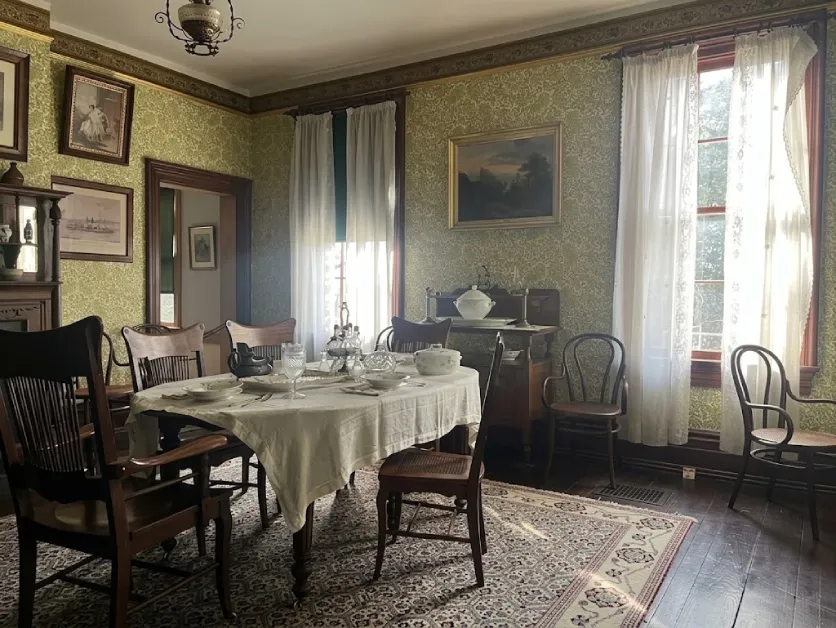
The dining room, parlor, and bedrooms are furnished with period pieces reflecting Douglass’s taste and social standing — elegant but not ostentatious. Outside, the Growlery has been reconstructed near its original site: a small, plain stone building in deliberate contrast to the main house, where Douglass retreated when Cedar Hill’s bustle became too much.
The Visitor Center
Before or after the house tour, the visitor center at the base of the hill offers exhibits, a life-size statue, and a short orientation film with historical reenactments that set the stage for the walk up to Cedar Hill.
From Private Home to National Historic Site
Early Preservation Efforts
After Douglass’s death, his widow Helen Pitts Douglass worked to preserve his legacy, and in 1900 succeeded in having Congress charter the Frederick Douglass Memorial and Historical Association (FDMHA). When Helen died in 1903, the FDMHA inherited the estate. In 1916, the National Association of Colored Women’s Clubs joined the preservation effort.
Restoration and Federal Designation
In the 1920s, architect William Augustus Hazel restored the house, completing the work in 1922 — one of the earliest U.S. historic preservation projects led by a Black architect. The federal government took the deed in 1962, making Cedar Hill a National Park Service unit. It was added to the National Register of Historic Places in 1966, and Congress formally designated it the Frederick Douglass National Historic Site in 1988. In 2020, the National Register nomination was amended to also recognize Helen Pitts Douglass’s preservation work.
Preserving the House Today
The NPS maintains Cedar Hill under strict preservation standards. Cultural Landscape Reports and Historic Structure Reports completed around 2020 inform a comprehensive master plan for the full eight-acre property. Because roughly 70% of the furnishings are originals, climate control, pest management, and careful handling protocols are essential — which is also why every tour group is capped at ten people. The National Park Foundation and other organizations supplement federal funding with grants for structural repairs and educational programming.
The Economic Footprint of Frederick Douglass Properties
The financial dimensions of Douglass-related properties extend beyond what a typical historic site generates.
Record Sales and Heritage Grants
In 2021, Douglass’s earlier Washington residence — where he lived from 1871 to 1877 before purchasing Cedar Hill — sold for $4.995 million, a record for the surrounding neighborhood. Government investment continues too: Maryland’s African American Heritage Preservation Program awarded $106,000 in 2025 for preserving Douglass’s Highland Beach summer home, part of a broader $5 million investment across 31 organizations statewide.
A Free Site with Real Costs
The Frederick Douglass National Historic Site itself charges no entrance fee, prioritizing access over revenue. Even so, the site demands substantial resources for maintenance, staffing, and conservation — costs borne primarily by the National Park Service. The broader economic impact radiates into Anacostia and Southeast Washington, where the site anchors heritage tourism beyond the typical National Mall circuit.
Douglass’s Enduring Cultural Legacy
Frederick Douglass’s influence didn’t end the day he died. If anything, it continues to deepen with each generation.
Words That Still Resonate
His 1852 address, “What to the Slave Is the Fourth of July?”, is read aloud every Independence Day at events across the country. Mass Humanities’ “Reading Frederick Douglass Together” program, which pairs public readings of the speech with discussions and performances, expanded to sixty Massachusetts communities in 2024.
A Champion of Women’s Rights
Douglass attended the 1848 Seneca Falls Convention and was one of the few men to sign the Declaration of Sentiments. In 1866, he joined Elizabeth Cady Stanton and Susan B. Anthony in founding the American Equal Rights Association to demand universal suffrage — a lifelong belief that the fight for freedom could not be compartmentalized.
The Most Photographed Man of His Era
Douglass sat for more portraits than even Abraham Lincoln, deliberately using photography to present a dignified vision of Black manhood at a time when racist caricatures dominated public imagery. That visual legacy endures on murals, monuments, and stamps — and in 2017, Cedar Hill itself was featured on a U.S. quarter representing Washington, DC.
Visiting the Frederick Douglass House
Getting There and Booking Tickets
The Frederick Douglass National Historic Site is located at 1411 W Street SE, Washington, DC 20020, about a 10-minute walk from the Anacostia Metro station. The grounds are open Tuesday through Saturday, 9:00 AM to 5:00 PM during peak season (April 15–October 15) and 9:00 AM to 4:00 PM the rest of the year. There’s no entrance fee, but a timed-entry reservation is required year-round for the Historic House Tour — book through Recreation.gov well in advance, as slots fill fast.
The experience starts at the visitor center for the orientation film and exhibits, then continues with a park ranger leading the roughly one-hour guided walk up to Cedar Hill. Those who can’t visit in person can take the National Park Service’s virtual tour instead.
For Families and Students
Kids can complete a booklet to become a Junior Ranger, while students can take part in the site’s Annual Oratorical Contest, honing the same public-speaking skills Douglass himself mastered.
The historic hilltop location means there are significant steps leading up to the house and stairs between floors. Visitors with mobility limitations should contact the site ahead of time to discuss accommodations. The visitor center itself is fully accessible, with restrooms and exhibit spaces on a single level.
Nearby Sites and Supporting Cedar Hill
The National Museum of African American History and Culture on the National Mall holds additional Douglass artifacts, and Baltimore’s Fell’s Point neighborhood marks locations from his pre-escape years. You can support Cedar Hill’s preservation by donating directly, shopping at the gift shop, or joining the Frederick Douglass Memorial and Historical Association or the National Park Foundation.
Conclusion
Cedar Hill isn’t just where Frederick Douglass happened to live out his final years — it’s where his entire life’s work came into focus. The same man who once risked everything to learn his letters in secret spent his last two decades surrounded by more than a thousand books, entertaining presidents and reformers, and looking out at a Capitol dome that once symbolized a country that considered him property.
That contrast is what makes visiting here different from reading about Douglass in a textbook. Standing in his library, walking the grounds he expanded acre by acre, or stepping inside the Growlery where he wrote in solitude connects you to the man behind the monument in a way words alone can’t.
Whether you’re drawn by the history, the architecture, or Douglass’s ongoing relevance to conversations about race, freedom, and equality, Cedar Hill rewards the trip. Book your timed-entry tour early, plan for the hill’s steps, and give yourself time afterward to sit with what you’ve seen — because few historic homes in America carry this much weight in so few rooms.
