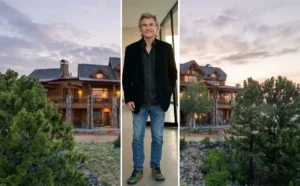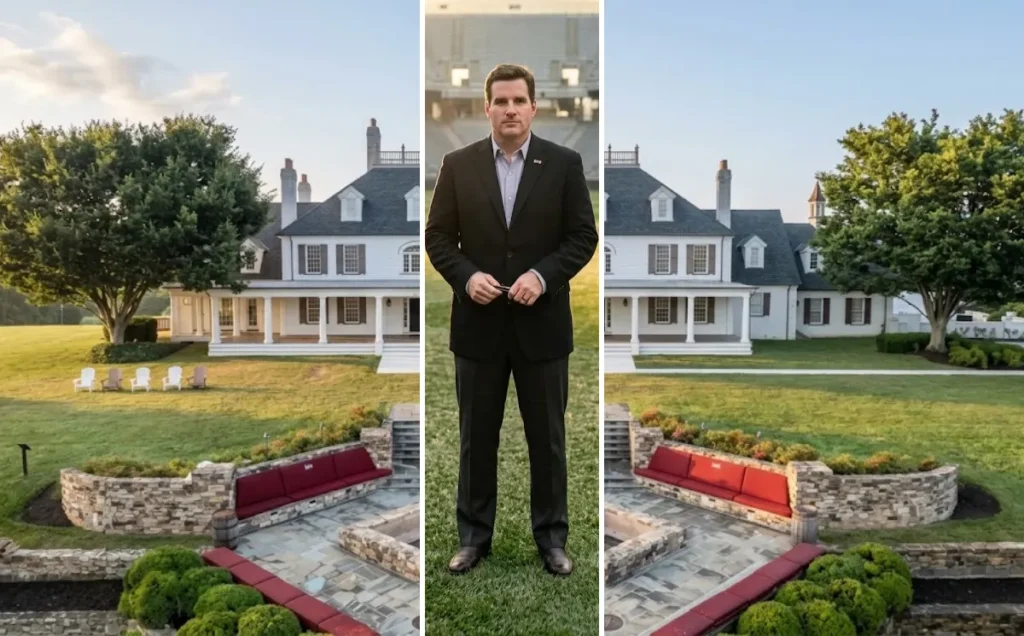
Kevin Plank started Under Armour out of his grandmother’s basement in Georgetown. Seventeen years later, he bought a 12,000-square-foot federal-style mansion a few streets away for about $7.85 million and installed a marble grand staircase weighing 22,000 pounds and costing close to $1 million.
He asked $29.5 million for it, then $24.5 million, and sold it in 2020 for $17.25 million. The same pattern is now playing out at Sagamore Farm, the historic Maryland horse property he bought in 2007 for a reported $4.99 million and spent more than $22 million on: listed at $22 million in early 2025, it has since been cut twice, to $16.5 million.
This guide covers both, and where he actually lives.
Kevin Plank’s properties at a glance
| Property | Location | Key figures | Status |
|---|---|---|---|
| Federal-style mansion, about 12,000 sq ft, roughly 200 years old | Georgetown, Washington, D.C. | Bought in 2013 for about $7.85 million; renovated from 2015; listed at $29.5 million, then $24.5 million; sold in 2020 for $17.25 million | Sold |
| Sagamore Farm, about 400 to 440 acres, main house around 16,000 sq ft | Reisterstown, Baltimore County, Maryland | Bought in 2007 for a reported $4.99 million; more than $22 million spent on land and renovations; listed in February 2025 at $22 million, cut twice to $16.5 million | On the market |
| Second Georgetown house | Georgetown, Washington, D.C. | Bought in 2011 for $1.5 million | Owned at the time of reporting |
Who is Kevin Plank?
Kevin Plank is the founder of Under Armour, which he started in 1996 while operating out of his grandmother’s basement in Georgetown, Washington. He built it into one of the largest sportswear companies in the world, served as chief executive until 2019, and returned to the role in 2024.
He also founded Sagamore Spirit, a Baltimore whiskey distillery, and is the figure behind the large Baltimore Peninsula redevelopment on the city’s waterfront, formerly known as Port Covington. He is closely identified with Baltimore, both commercially and personally.
The Georgetown basement is not a throwaway detail. It is the reason the Georgetown mansion purchase carried the resonance it did locally.
The Georgetown mansion
Plank and his wife bought the Georgetown house in 2013 for about $7.85 million. It is a Federal-style property roughly two hundred years old, running about 12,000 square feet, in one of the most expensive and tightly held residential districts in the United States. He had already bought a smaller Georgetown house in 2011 for $1.5 million.
What followed was a comprehensive renovation, carried out with the Baltimore interior designer Patrick Sutton from around 2015. The best-known element is a marble grand staircase weighing 22,000 pounds and reported to have cost close to $1 million on its own. The work also added a cellar room for whiskey and cigars, a heated pool and a separate gym.
Then came the sale, and it did not go smoothly. The house was listed at $29.5 million, reduced to $24.5 million in 2019, and finally sold in 2020 for $17.25 million.
Against $7.85 million paid, $17.25 million is a nominal gain of $9.4 million. Set against it are a renovation in which a single staircase accounted for around $1 million, seven years of carrying costs on a $17 million Georgetown property, and agent commissions, and the actual return is far smaller and quite possibly negative. It is also $12.25 million below the opening ask.
Sagamore Farm
Sagamore Farm is not an ordinary horse property. The Reisterstown estate was owned by the Vanderbilt family and produced Native Dancer, one of the most celebrated American racehorses of the twentieth century. Plank bought it in 2007 for a reported $4.99 million to run a thoroughbred breeding and racing operation.
The estate runs to roughly 400 to 440 acres and includes a main house of around 16,000 square feet, a five-bedroom general manager’s house and a building containing eight apartments. Reporting puts his total spending on the land and its restoration at more than $22 million.
He listed it in February 2025 at $22 million, which would roughly have returned what he had put in. It has not sold. The Baltimore Sun reported in April 2026 that the asking price had been cut for the second time, to $16.5 million.
Very large agricultural estates with specialised infrastructure are among the slowest properties in any market. The buyer has to want that specific thing, at that scale, in that place, and the pool is tiny. The same difficulty appears in the account of Herb Chambers’s Boston properties, where an unusually high-end property took years and repeated reductions.
Where does Kevin Plank live now?
Baltimore County, Maryland.
Reporting on the Georgetown house was explicit that it was not his primary residence: his main home has consistently been described as being in Baltimore County. That is consistent with everything else about him, since Under Armour is headquartered in Baltimore, his distillery is in Baltimore, and his largest development project is on the Baltimore waterfront.
Whether he lives at Sagamore Farm itself is not clearly established. The estate has a substantial main house, and he owned it for nearly two decades, but the reporting on the listing does not state that it was his residence, and it is being marketed as a working farm rather than as a family home. If he does live there, the sale would represent a move.
No other property has been identified as his primary home, and no purchase since 2013 has been reported. The honest position is that he is based in Baltimore County and that the specific house has not been publicly documented.
What the two sales show
Plank has now twice bought a distinctive property, spent heavily on making it exactly what he wanted, and found that the market would not pay for the work.
That is not a criticism of either project. A $1 million staircase in a 200-year-old Georgetown house and a restored Vanderbilt horse farm are both defensible things to do with money if you want them. It is simply a reminder, repeated throughout this site, that renovation spending is very rarely recovered at resale, and that the more specific the vision, the smaller the eventual audience. The point holds for corporate founders as reliably as it does for entertainers, as the record on Tilman Fertitta’s Houston properties also indicates.
Sources
- The Baltimore Sun on the 2013 Georgetown purchase, the renovation with Patrick Sutton, the marble staircase and the successive listings.
- The Georgetowner on the 2020 sale at $17.25 million.
- Washingtonian on the February 2025 Sagamore Farm listing, the 2007 purchase price and the total spent on the estate.
- The Baltimore Sun on the second reduction in the Sagamore Farm asking price.