
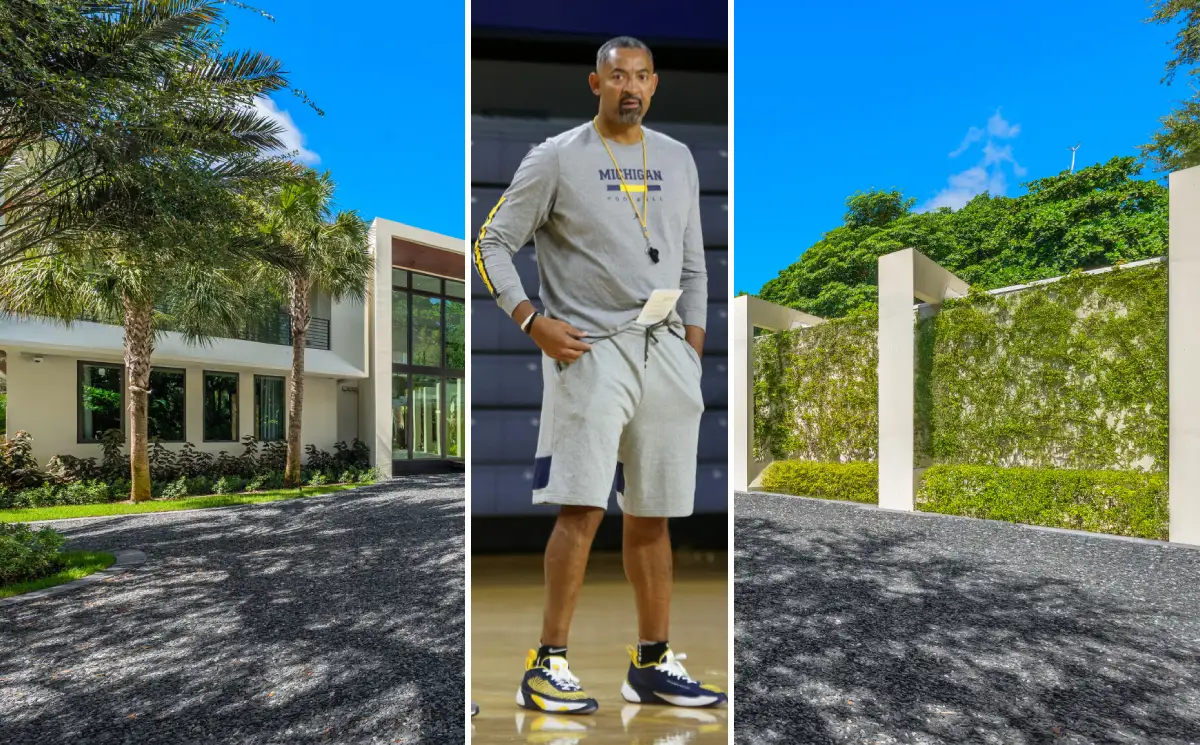
Juwan Howard earned his place in basketball history as a member of Michigan’s legendary Fab Five, built an 18‑year NBA career across eight franchises, and signed one of the first $100 million contracts the league had ever seen.
But his story doesn’t stop at the arena doors.
The Juwan Howard house portfolio — stretching from Ann Arbor to Chicago, Coral Gables, and beyond — reflects a quieter, more deliberate narrative: a man who turned professional sports earnings into a carefully managed real estate legacy built around family. Each property was chosen not for status, but for its unique character, practical utility, and ability to anchor the Howards during life’s changing seasons.
From Chicago’s South Side to waterfront estates — a blueprint for family‑first investing
Quick Facts
| Full Name | Juwan Antonio Howard |
| Estimated Net Worth | ~$80 million |
| Current Portfolio (Est. Market Value) | $8M+ across active holdings |
| Crown Jewel | Coral Gables waterfront estate (purchased for $3.4M in 2013) |
| Longest‑Held Asset | Chicago Museum Park townhouse — held ~30 years |
| Primary Strategy | Long‑term hold · established neighborhoods · family‑centric |
| Key Advisors | Jenine Howard (design) · Dwyane Wade & Grant Hill (Miami market intel) |
| Notable Sale | Trump Tower Chicago condo — sold in 2015 for ~$2.775M |
The Ann Arbor Estate
When Howard returned to the University of Michigan as head coach in 2019, he and his wife Jenine settled into a home near campus that quickly became the family’s anchor. The residence sits on a half‑acre lot shaded by mature oaks, blending the suburban calm of Ann Arbor with clean, contemporary design. Floor‑to‑ceiling windows fill the main living area with natural light, and the space doubles as a gallery of sorts — basketball memorabilia from his playing days lines the walls alongside family photos.
Jenine guided the interior design herself, pairing white stone surfaces with warm hardwood floors throughout. The kitchen features professional‑grade appliances and a large center island where the family gathers for daily meals. A dedicated film room — fitted with a projector and tiered seating — became Howard’s command center for late‑night coaching sessions, while a quiet study with built‑in shelving offers a respite for reading and game planning. Outside, a bluestone patio with a gas fire pit overlooks the fenced backyard, where the couple’s younger children often practice dribbling drills on a custom‑poured concrete pad.
Upstairs, the primary suite is deliberately tucked away from the common areas, giving the couple a degree of privacy in what is otherwise a busy household with several children. The home also includes a finished lower level with a wet bar and a guest suite — ideal for visiting relatives and former teammates.
Howard’s coaching tenure at Michigan ended in 2024, but the Ann Arbor home remains a meaningful address for the family. It’s where the coaching chapter played out — late‑night film sessions, early‑morning practices, and the everyday rhythm of raising kids in a college town.
Chicago: Where It All Began
Howard grew up on Chicago’s Near South Side, raised largely by his grandmother Jannie Mae. That early experience — learning the value of stability and a solid roof over your head — shaped his entire approach to property later in life.
His first significant real estate move was a townhouse in Chicago’s Museum Park neighborhood, in the South Loop. The roughly 3,100‑square‑foot home, purchased in 1996 for around $490,000, featured curved bay windows, twin fireplaces, and a small wine cellar tucked behind the living room. The three‑story layout included a rooftop terrace with panoramic skyline views, a cozy breakfast nook overlooking a private garden, and a finished basement that doubled as a game room for his children during visits. Three bedrooms doubled as display spaces, with jerseys and keepsakes from his NBA years scattered throughout. It was part residence, part personal museum — a place where the Fab Five origins and professional career coexisted under one roof.
Howard held onto the property for nearly three decades before selling it in early 2025 for $875,000. That’s a solid return by any measure, and it reflected both Chicago’s evolving South Loop market and his patient, long‑hold approach to real estate. Museum Park had transformed considerably since the late ’90s, and his willingness to wait out the cycles paid off.
He also owned a 47th‑floor unit in Trump International Tower in downtown Chicago, which sold in 2015 for approximately $2.775 million. That transaction marked an early shift in his thinking — moving away from high‑rise condos toward properties with more land, more privacy, and more room for a growing family.
Coral Gables: The Waterfront Flagship
Howard’s time with the Miami Heat — from 2010 through 2013, including two NBA championship runs — introduced him to South Florida living. He didn’t leave when the final buzzer sounded on his playing career.
In late 2013, he purchased a 5,409‑square‑foot waterfront estate in Coral Gables for $3.4 million. The property sits inside a gated community on Biscayne Bay and features five bedrooms, vaulted ceilings, a circular pool, and a rooftop terrace. The design blends Mediterranean influence with clean modern lines — red brick and coral‑stone on the exterior, open‑concept living spaces inside with bay views from nearly every room. A private dock with a 12,000‑lb boat lift provides direct access to the bay, while a summer kitchen with a built‑in grill and pizza oven makes al fresco entertaining effortless.
The kitchen matches the rest of the home’s ambition: professional appliances, a center island built for entertaining, and a temperature‑controlled wine room. Marble flooring runs throughout the main level, and a whole‑home Crestron automation system manages lighting, security, and climate with a single touch. Outside, covered lounges overlook the water. Jenine added her touch here too, creating a poolside area designed for family movie nights under the stars — complete with a retractable screen and built‑in speakers.
This was a deliberate upgrade from the Chicago condo lifestyle. Howard reportedly consulted with teammates like Dwyane Wade and Grant Hill on South Florida property moves — players who had already established deep roots in the area and understood its market dynamics. The Coral Gables estate represents the high‑water mark of his real estate portfolio, both literally and figuratively.
A New Chapter
Following his departure from Michigan in 2024, reports have linked Howard to a coaching role with the Brooklyn Nets. If accurate, the move would add another property market to his portfolio — and it fits a familiar pattern.
Brooklyn and the surrounding boroughs have attracted several NBA figures in recent years, drawn by the combination of franchise proximity and cultural energy. A downtown penthouse with floor‑to‑ceiling windows and a wraparound terrace — offering panoramic views of the Manhattan skyline — would represent yet another pivot in Howard’s real estate story, shifting from waterfront tranquility back to urban density as his professional life demands.
Regardless of the specific address, the underlying logic holds: every Juwan Howard house decision has followed his career trajectory while keeping family needs at the center. He doesn’t buy properties for status. He buys them because they serve a purpose in the chapter he’s living.
Family at the Core
Every home Howard has owned shares a common trait — it’s designed for a full household. Jenine has personalized each property to accommodate their children, creating spaces that balance everyday function with moments of comfort. In Ann Arbor, that meant a dedicated playroom with soft flooring and low shelving; in Coral Gables, it’s the poolside hangout with shallow‑entry steps for little swimmers; in Chicago, the townhouse dining room hosted neighborhood gatherings and community outreach events.
Their children have made memories at each address. Basketball naturally spills into the living spaces — hallways become dribbling courts, driveways become practice lines. It’s an athlete’s household in the truest sense, where the sport that built the family’s fortune also fills its daily life.
Privacy and security have been non‑negotiable across every property. Biometric entry systems, 24/7 monitored cameras, and landscaped privacy hedges keep the family shielded from unwanted attention. When the Howards have moved, they’ve worked with trusted legal and real estate advisors to handle transactions cleanly, making each transition as smooth as possible for the kids.
The Real Estate Playbook
Howard’s estimated net worth sits around $80 million, built through a combination of NBA earnings, his roughly $3.51 million annual coaching salary at Michigan, endorsement deals, and a steadily growing property portfolio.
His approach to real estate is methodical and, frankly, more disciplined than what you see from most athletes. He favors holding assets long‑term, monitoring property tax assessments and market cycles before deciding when to sell. The Museum Park townhouse is a textbook example: bought low in the mid‑’90s, held through decades of neighborhood growth, and sold when the numbers made sense.
He’s also shown a willingness to trade up strategically. The shift from Chicago high‑rise living to Coral Gables waterfront property reflected both a lifestyle evolution and an investment thesis — land and waterfront access tend to hold value more reliably than condos in saturated downtown markets.
Howard isn’t alone in this strategy. Fellow NBA veterans like LeBron James and Ray Allen have built significant property portfolios using similar principles: buy in desirable locations, hold through market fluctuations, and let appreciation do the heavy lifting. But Howard’s version stands out for its restraint. He hasn’t chased speculative developments or trendy markets. His properties sit in established neighborhoods where the fundamentals — school districts, waterfront access, proximity to work — are already proven.
Conclusion
The Juwan Howard house story isn’t really about square footage or sale prices. It’s about a kid from Chicago’s South Side who learned early that a stable home changes everything — and then spent his adult life making sure his own family always had one.
Each property in his collection marks a different chapter. The Chicago townhouse carries the Fab Five origins and early NBA years. The Coral Gables villa holds the championship‑era Miami connection. The Ann Arbor estate holds the coaching chapter. And wherever the next address lands, it’ll follow the same playbook that’s served him for three decades: buy smart, hold steady, and put family first.
For anyone studying how professional athletes can build lasting wealth beyond their playing careers, Howard’s real estate journey offers a practical blueprint. Patient timing. Established markets. Family‑centered decisions. Substance over spectacle. Not a bad set of principles — whether you’re managing a multi‑million‑dollar portfolio or buying your first home.
