
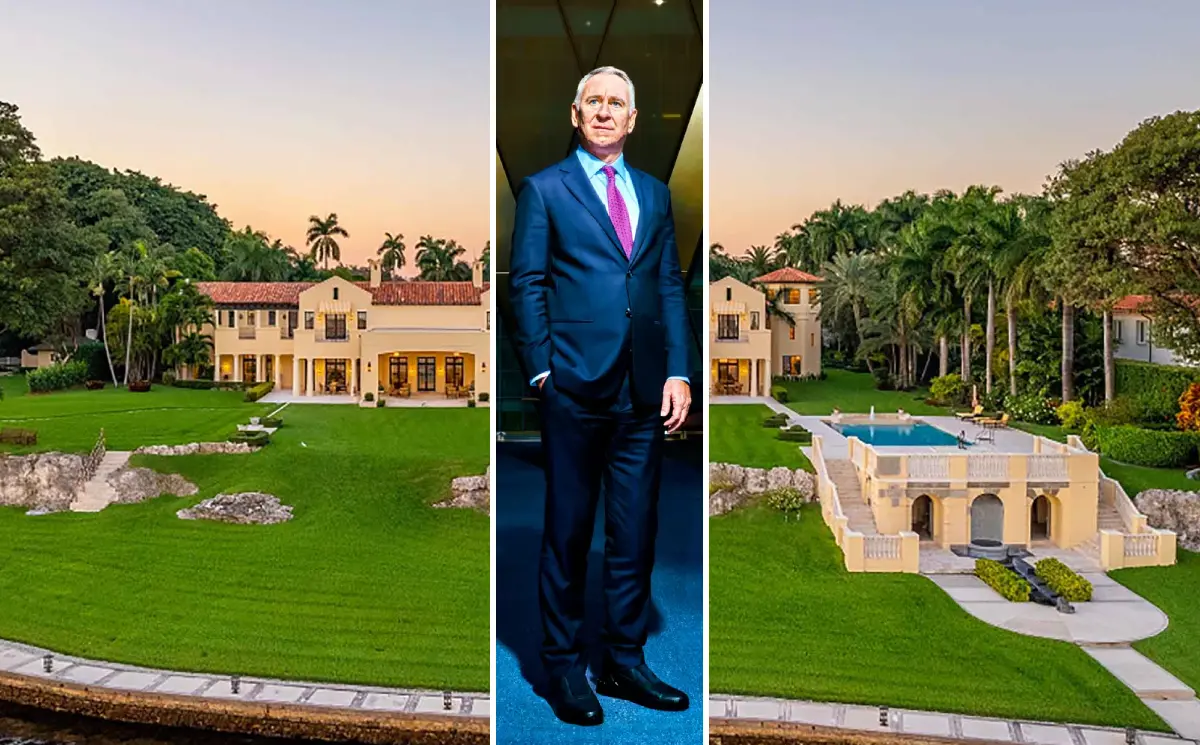
Kenneth Griffin doesn’t do anything small. The Citadel founder has spent the last decade quietly buying up more than 27 acres of prime Palm Beach coastline, spending roughly $450 million on land alone, and demolishing luxury mansions that most people would consider dream homes. The goal? Building what’s expected to become the most expensive private residence on the planet — a mega-estate valued at approximately $1 billion.
The Kenneth Griffin house project sits on South Ocean Boulevard’s stretch locals call “Billionaires’ Row,” about a quarter mile south of Mar-a-Lago. It’s the largest single residential parcel in Palm Beach, eclipsing even Donald Trump’s nearly 20-acre estate.
And construction is well underway.
Breaking Down the $1 Billion Kenneth Griffin House
The numbers behind this project are staggering even by billionaire standards. Griffin began acquiring individual parcels in 2012, and the process took more than ten years of methodical negotiation. He purchased over 20 separate properties, paid premium prices to convince holdout sellers, then tore down what stood there to make room for something entirely new.
What’s replacing those demolished estates: a contemporary compound with over 50,000 square feet of living space. The main residence stretches longer than a football field, with deep roof overhangs, clean geometric lines, and floor-to-ceiling glass designed to frame uninterrupted views of the Atlantic Ocean. The architectural approach has been described as a “see-through house” — visitors reportedly catch glimpses of pools and open water the moment they step inside.
Renderings show a spectacular swimming pool that extends from the main residence toward the ocean, flanked by manicured gardens and expansive lawns. Multiple guest houses, a clay tennis court on a separate 2.6-acre parcel, and resort-level landscaping round out the grounds. The property spans roughly 1,400 feet of coastline, with views stretching from the ocean to the Intracoastal Waterway.
The first mansion in the compound isn’t for Griffin himself — it’s for his mother, Catherine Gratz Griffin. A spokesperson confirmed that Griffin, who relocated to Miami when Citadel moved its headquarters from Chicago in 2022, plans to use the full estate as his retirement residence down the road.
A Decade of Strategic Land Assembly
Griffin’s approach to building the Kenneth Griffin house wasn’t impulsive. It was a slow, calculated accumulation that real estate experts compare to assembling a jigsaw puzzle where every piece costs eight figures.
The timeline tells the story. Griffin started in 2012 with early acquisitions on Blossom Way. He continued adding parcels through 2015, when a neighboring property cost him $15.25 million. A major purchase came in 2017 on South Ocean Boulevard for $85 million — which he promptly demolished. By mid-2019, he’d secured a $105 million ocean-to-lake mansion, and the final pieces pushed his total land investment to approximately $450 million.
In May of a recent filing year, Griffin took a significant administrative step: he applied to consolidate all his Blossom Way parcels with his Ocean Boulevard properties into a single estate. The Palm Beach Architectural Commission approved the main residence’s plans in June 2022, green-lighting the long, lean contemporary structure that anchors the northern portion of the property.
Architectural Details: What We Know So Far
Design documents and renderings that have emerged paint a picture of restrained opulence. The architecture leans heavily on natural materials — limestone, wood, and glass — with a neutral palette and deep overhangs that provide shade and visual weight. Pergolas connect different structures across the property, creating covered walkways that evoke a resort rather than a single-family home.
The layout draws on tropical resort influences, with different buildings serving different functions spread across the expansive lot. The main residence and guesthouse together account for the 50,000-plus square feet, but the compound’s full footprint includes pools, recreational facilities, and staff quarters that multiply the built area considerably.
One element that’s drawn attention: the swimming pool design. Renderings show a pool with glass walls on both sides that frame Atlantic Ocean views — a feature more commonly associated with luxury resorts in the Maldives than with private Palm Beach residences.
Griffin’s Broader Real Estate Footprint
The Palm Beach mega-estate is the crown jewel, but it’s part of a portfolio that spans the country and reflects a deliberate shift toward Florida.
New York City
Griffin holds a $238 million quadplex penthouse at 220 Central Park South — the most expensive residential sale in U.S. history when he bought it. He’s also accumulated units on Park Avenue, paying $45 million for a duplex from Julia Koch in early 2025 and another $38 million for an adjacent duplex shortly after, bringing his holdings in that building to roughly $83 million. He still has a Park Tower penthouse on Michigan Avenue listed at $15.75 million, his last remaining Chicago property.
Miami
Griffin paid $106.9 million in 2022 for a Coconut Grove waterfront estate, setting a Miami-Dade record. He’s also assembled roughly $169 million worth of properties across seven contiguous lots on Star Island. Most recently, he applied to build a private megayacht marina on Terminal Island — a 30,000-plus-square-foot facility with docking for his superyacht and those of visiting guests.
Hawaii
He’s spent about $28 million on two oceanfront properties within the Four Seasons Resort Hualalai on the Kona Coast.
Aspen
Additional mountain properties round out a collection that industry insiders value well beyond $1 billion in total residential holdings.
The Chicago sell-off tells its own story. Griffin has been systematically liquidating his Windy City assets since Citadel’s relocation, a move he’s publicly attributed to frustrations with the city’s governance and business climate.
Why Palm Beach — and Why Now
Griffin’s spokesperson has pointed to Florida’s pro-growth and pro-business policies as the driving force behind the area’s skyrocketing property values. Palm Beach has always attracted wealth, but the post-2020 migration wave — accelerated by remote work flexibility, tax advantages, and pandemic-era relocations from New York, California, and Illinois — sent demand into overdrive.
Griffin is a Florida native, born in Daytona Beach and raised in Boca Raton. So the move home carries personal significance beyond the financial calculus. But there’s no denying the investment logic: with an estimated net worth of $48 to $50 billion, owning the most valuable private estate in America is less about extravagance and more about long-term positioning in a market with finite supply.
The ripple effects are real. Industry consultants in Miami have noted a “Griffin effect” — when one of the wealthiest people in the world puts hundreds of millions into a specific market, other ultra-high-net-worth buyers follow. Jeff Bezos’s recent Miami purchases have been partially attributed to the signaling effect of Griffin’s relocation.
Construction Realities
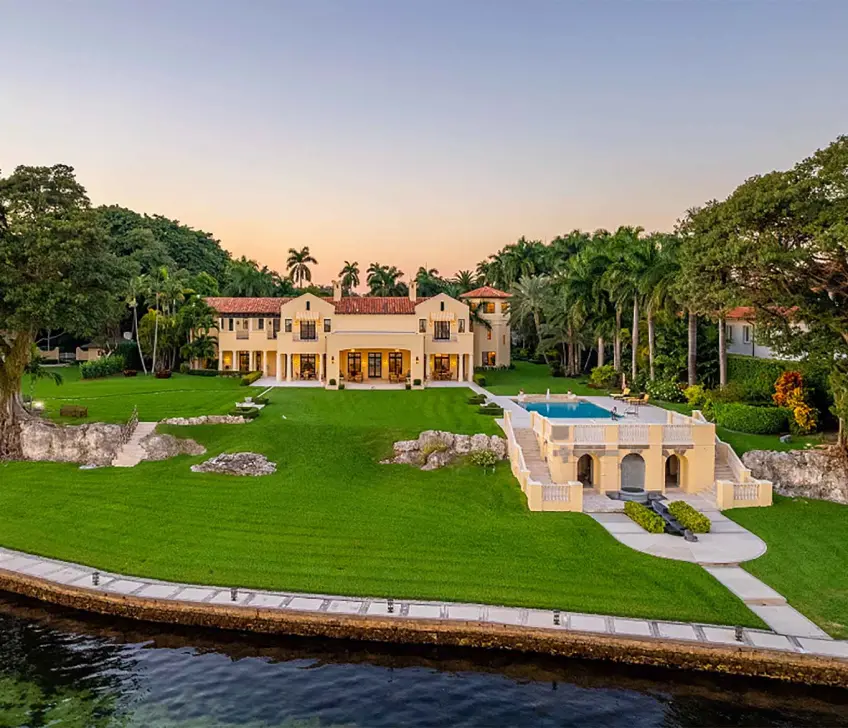
Building a $1 billion estate on the Florida coast isn’t straightforward. The project requires hurricane-resistant engineering, elevated construction to address sea-level concerns, upgraded seawalls, and environmental compliance measures that don’t apply to typical luxury builds. Every element is custom — there’s no template for what Griffin is attempting.
Construction machinery appeared on site as early as late 2023, and photos from 2024 and 2025 show significant progress on the northern portion of the compound. Industry estimates suggest three to five years of active construction from the initial groundbreaking, putting full completion somewhere in the late 2020s.
The scale of coordination alone is unusual for a private residence. Specialized contractors, custom material sourcing from around the world, and multi-phase regulatory approvals across different sections of the property all compound the timeline.
Conclusion
Before Griffin’s Palm Beach project, the upper ceiling of residential real estate hovered around $200 to $250 million for a single property. At $1 billion, Griffin isn’t just breaking a record — he’s creating an entirely new tier. Industry observers have started using terms like “mega-estate” to describe properties that exceed traditional luxury categories.
The implications extend beyond one billionaire’s personal residence. If completed at its projected value, the Kenneth Griffin house will reset expectations for what the ultra-wealthy are willing to build and own. It also raises practical questions about coastal development, engineering resilience, and how much private capital will continue flowing into climate-vulnerable waterfront locations.
For Palm Beach specifically, the project cements the town’s position as America’s most exclusive residential address. Billionaires’ Row wasn’t coined lightly — and Griffin’s decision to build the world’s most expensive home there reinforces a concentration of wealth that shows no signs of dispersing.
When the estate is finished, it won’t just be where Ken Griffin lives. It’ll be a landmark that redefines what American luxury real estate looks like at the very top.
