
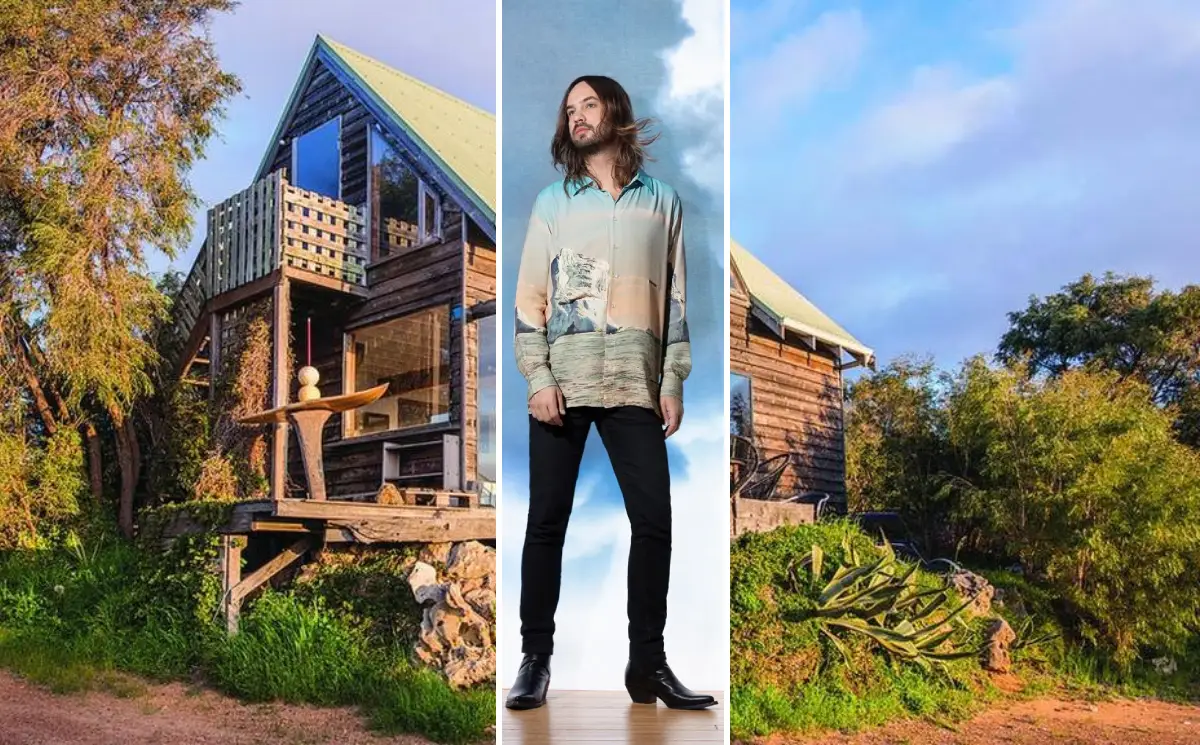
Kevin Parker turned a bedroom in Fremantle, Western Australia, into one of the most important recording spaces of the 2010s. From there, he built Tame Impala into a global phenomenon. Somewhere along the way, he also started quietly buying property — with the same thoughtfulness he brings to a synth patch.
His real estate doesn’t follow the usual celebrity playbook. No sprawling Beverly Hills mansion. No Dubai penthouse. Instead, the Tame Impala frontman has assembled a small handful of properties that each pull double duty. They’re where he lives, where he records, and — in one case — where other artists made music history decades before he bought in. The Kevin Parker house story is really about a musician who figured out that owning your creative infrastructure beats renting someone else’s.
So where does Kevin Parker actually live? He splits his time between two homes. One is in Fremantle, Western Australia — part of the greater Perth area, where he grew up and still records. The other is in the Los Feliz area of Los Angeles, where he lives with his wife and daughter. He also owns a third property, Wave House on the Western Australian coast, and uses it mainly as a working studio.
Quick facts:
- Current home base: Fremantle, Western Australia (Greater Perth), and Los Angeles, California
- LA home: 1920s Spanish-style house in Los Feliz (some earlier press called it Hollywood Hills), purchased around 2019
- Wave House: Yallingup, Western Australia (Margaret River region) — bought for A$2.75 million in 2020
- Fremantle home studio: Still Parker’s primary working studio, used for every Tame Impala album to date
A 1920s Spanish-Style Home in Los Feliz (Los Angeles)
Parker’s American home sits in Los Feliz, the hillside neighborhood east of Hollywood. Musicians and actors have long chosen this area for its proximity to the industry, without the Sunset Strip circus. Some earlier press coverage, closer to when Parker bought the house, placed it in the neighboring Hollywood Hills instead. The two areas sit right against each other in that part of LA, and outlets have used both names for the same property. The house itself is a Spanish-style build from the 1920s, with arched doorways and the kind of old-Hollywood character that new construction can’t replicate.
Vogue Living profiled the home in 2022. The feature showed how the singer-songwriter and his wife, Sophie Lawrence, built his creative workflow into a family space. The couple lives there with their daughter, Peach, born in January 2021, and they announced a second child on the way in mid-2025.
How the Fire and the Purchase Lined Up
The house came into the picture around a rougher moment. In November 2018, Parker was renting an Airbnb in Malibu to work on what became The Slow Rush when the Woolsey Fire swept through the area. He evacuated with little more than his laptop and his vintage Höfner bass; the fire destroyed the rest of his gear. He and Lawrence were already in the process of buying this Los Feliz property around that time. By the time journalists visited in early 2020, the house was still barely furnished — one interview account mentions a single mattress on the floor.
The location works well for a musician-producer with an active career. Parker’s songwriting and production credits stretch across a long list of artists, including Dua Lipa, Rihanna, Gorillaz, Travis Scott, and Mark Ronson. Living close to studios in Hollywood and Silver Lake keeps him within reach of that side of his career, without putting him in the middle of it. The house reads less like a trophy purchase and more like a functional base — a family home that also happens to be a short drive from a session.
Wave House: The A$2.75 Million Studio With Music History Built In
In 2020, Parker made his most significant property move yet. He bought Wave House in Yallingup, a coastal area in Western Australia’s Margaret River region, roughly four hours south of Perth. He and Lawrence paid A$2.75 million for it — down from an original asking price of around A$3.7 million.
This wasn’t a typical real estate play. Tame Impala recorded almost all of their debut album, Innerspeaker (2010), at Wave House — the record that took Parker from a Perth unknown to an international critical favorite. Parts of 2015’s Currents came together there too. Buying the property was part nostalgia, part strategy.
The estate covers roughly 50 acres of oceanfront land overlooking Injidup Beach and the Indian Ocean, with Leeuwin-Naturaliste National Park along the coast. The main residence spans three levels with four bedrooms and sleeps up to 12 guests. A separate two-bedroom guest house sleeps six more.
The feature that sets Wave House apart, though, is a natural limestone amphitheatre on the property that holds around 300 people. It’s the kind of amenity that’s equal parts luxury and working tool for someone who performs for a living.
A Studio With History That Predates Him
The recording history at Wave House goes back decades before Parker bought it. American producer Ken Eichenberg built the compound in the 1980s, and it has hosted sessions for the Beastie Boys, The Waifs, Fat Freddy’s Drop, and Fatboy Slim over the years. When Parker bought it, he wasn’t just acquiring a house — he was taking over a studio with real music-industry provenance.
The story didn’t stop in 2020, either. Wave House is still Parker’s working studio. Tame Impala recorded most of their fifth album, Deadbeat, released in October 2025, there and at his Fremantle home studio, during sessions in the first half of 2025. Fifteen years after making his debut record in that building, Parker made his most recent one there too — this time as the owner.
The Fremantle Home Studio Where It Started
Before any of this, there was a modest house in Fremantle, Western Australia. Fremantle is a port city that sits within the greater Perth metropolitan area, which is why interviews and profiles often describe Parker simply as a Perth-based musician, even though Fremantle is technically its own city.
Parker recorded the bulk of Currents (2015) largely on his own, working out of his home studio there. The album turned Tame Impala from a cult favorite into a genuine mainstream act. It also became a well-known piece of the band’s origin story: proof that a generation-defining record could come out of a house that looked like any other on the street.
The Fremantle setup isn’t just a piece of history, either. Parker has kept it part of his working routine ever since, including through the sessions for Deadbeat in 2025, which moved between Fremantle and Wave House. The progression from a modest Fremantle bedroom studio to co-owning a 50-acre coastal recording compound isn’t just a wealth story. It’s a fairly direct line from the DIY setup that built Tame Impala to the infrastructure Parker has around him now.
How the Properties Fit Together
Strip away the mythology, and the pattern across Parker’s homes is pretty consistent: each one does double duty as a place to live and a place to work.
The Los Feliz house keeps him connected to the American side of the music industry, where much of his production and songwriting work happens. Wave House ties him back to where Tame Impala’s sound was first shaped, and it’s still an active recording location today. The Fremantle home is where the whole project started, and it remains part of his routine. None of the three reads as a purely aesthetic or status purchase — Parker actually uses all of them.
The Same Logic Shows Up in His Business Moves
Parker has applied that same thinking beyond real estate. In May 2024, he sold his entire songwriting catalog to Sony Music Publishing, for an undisclosed sum. The deal covers his four Tame Impala albums plus his writing and production credits for artists including Dua Lipa, Rihanna, Gorillaz, and Travis Scott. Several major artists have made similar moves in recent years, as music catalogs have become valuable assets in their own right. It sits alongside his property choices as part of the same broader picture: an artist thinking carefully about the business side of a decades-long creative career.
Is Kevin Parker Wealthy? (Facts)
People searching for Kevin Parker’s net worth won’t find a confirmed number — and neither will you here. Publicly circulated estimates range anywhere from around $5 million to more than $60 million, depending on the source. None of them are backed by verified financial records or a statement from Parker himself. That’s a wide enough spread that none of it deserves to be treated as reliable.
The one concrete, confirmed financial event on record is the 2024 sale of his songwriting catalog to Sony Music Publishing, covering his four Tame Impala albums plus his production and writing credits for other artists — though even that deal’s price was never disclosed. Beyond that, what’s verifiable is what this piece already covers: the price he paid for Wave House, and the fact that he owns his properties outright rather than renting. Right now, no one can state a specific net worth figure as fact.
Conclusion
Parker has also branched into building instruments, not just buying property. In 2024, he co-founded Telepathic Instruments alongside Ignacio Germade and a small team. That December, the company launched its first product: the Orchid, a chord-generating synthesizer Parker says he first conceived more than a decade earlier. The first batch of 1,000 units sold out in January 2025. A second batch of 3,000 sold out in May 2025. The Orchid then saw a wider release in October 2025, and artists including Fred again.., Gracie Abrams, and Murda Beats have since picked one up.
Parker continues to split his time between Western Australia and Los Angeles — the same bi-continental rhythm that’s shaped his career since Tame Impala broke internationally. No properties have gone up for public sale, which points to a buy-and-hold approach rather than active flipping.
For now, the Kevin Parker house story stays fairly specific. It’s about a musician who spent his twenties recording in a borrowed bedroom, and has since put together a small group of homes and studios that all still get used for exactly what they’re for. Nor is it flashy. It’s just functional — and it tracks with everything else about how he works.
