
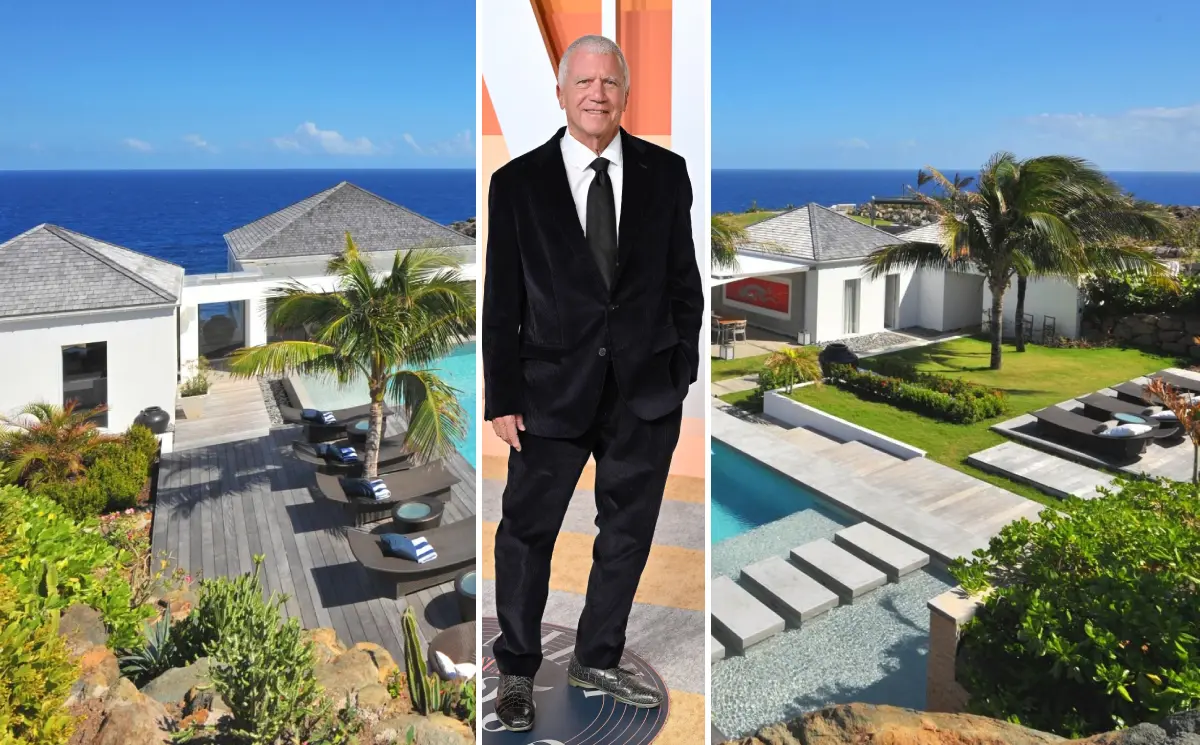
When someone has been called “the Starbucks of the art world—and its saviour,” you expect their homes to carry a certain weight. Larry Gagosian doesn’t disappoint. At 81, the mega-dealer who represents everyone from Damien Hirst to Richard Serra has assembled a residential portfolio north of $100 million—properties that double as private museums, networking venues, and strategic assets for his $600 million gallery empire.
Each Larry Gagosian house tells a different story about how one man blurred the line between living and collecting. Here’s how the pieces fit together.
A Portfolio Built Like a Gallery Network
Gagosian’s real estate philosophy mirrors the logic behind his 19 gallery locations worldwide: own the most significant space in every market that matters. New York. Los Angeles. The Hamptons. St. Barths. Each property sits near a cultural hub where collectors, artists, and serious money converge.
The result is more than a collection of expensive homes. These residences function as extension offices—places where $50 million deals start over sushi at Kappo Masa or end on a terrace overlooking the Caribbean. Winning and dining have always been central to high-stakes art dealing, and Gagosian operates the same way. His homes provide the stage.
What separates his approach from typical trophy-home buying is intentionality. He targets properties with architectural pedigree, cultural significance, and enough square footage to house serious art collections under museum-grade conditions. The Larry Gagosian house strategy prioritizes function as much as form.
The Harkness Mansion: A 50-Foot Manhattan Fortress
The centerpiece of Gagosian’s residential holdings is the Harkness Mansion at 4 East 74th Street on Manhattan’s Upper East Side. This 50-foot-wide megamansion—one of the widest private residences on the Upper East Side—cost Gagosian $36.5 million, a price that stunned the market when it was first reported.
Previous owner J. Christopher Flowers had paid significantly more for the property years earlier, making Gagosian’s acquisition a textbook example of opportunistic buying during a softer luxury market. The mansion’s enormous footprint gave him something rare in Manhattan: room to display museum-scale works by artists like Andy Warhol, Roy Lichtenstein, and Picasso without compromising residential comfort.
The Upper East Side location is no accident. Gagosian’s flagship gallery operations sit within walking distance, and the neighborhood’s density of major collectors creates constant informal contact. You can’t put a price on bumping into the right buyer on a Sunday walk.
The East 69th Street Carriage House: Sold but Not Forgotten
Before the Harkness Mansion, there was 147 East 69th Street—a Lenox Hill carriage house that Gagosian purchased in 1988 and transformed into a single-family residence nicknamed “House for a Bachelor.”
The renovation, executed by architect François de Menil, earned a 2000 AIA New York Design Award for interior architecture. De Menil reimagined the late-19th-century structure as a sophisticated living gallery, with spaces engineered to accommodate rotating exhibitions of blue-chip art in a domestic setting. The concept—merging serious collecting with genuine livability—influenced how other wealthy collectors approached their own renovations.
Gagosian eventually sold the carriage house for $18 million to fellow art collector Sasha Bauer, chairman of the SculptureCenter in Long Island City. The sale was a strategic consolidation: with the Harkness Mansion secured, maintaining two massive Upper East Side properties made less sense than concentrating resources. Bauer’s deep ties to the art world ensured the building would continue serving its cultural purpose—a detail that mattered to Gagosian.
The transaction also underscored how well Gagosian’s long-hold strategy pays off. Three decades of ownership, a landmark renovation, and a sale to a buyer who would honor the property’s artistic legacy. Not bad for a purchase made before most people knew his name.
Toad Hall: The Hamptons Art World Stage
In Amagansett, Gagosian owns Toad Hall—an approximately 11,000-square-foot estate designed by architect Charles Gwathmey. Originally built for François de Menil, the modernist structure has become Gagosian’s primary summer residence and one of the Hamptons’ most sought-after invitation addresses.
The guest list at Toad Hall reads like a cultural cross-section: artists, collectors, celebrities like U2’s Bono, and the kind of dealmakers who move between galleries and boardrooms. Gagosian exploits the relaxed Hamptons atmosphere to build relationships that formal gallery settings can’t replicate. Some of his most consequential transactions reportedly began here, over long dinners that stretched past midnight.
A 2015 electrical fire damaged the guest house, but Gagosian restored it quickly—reinforcing the property’s role as an irreplaceable piece of his operational infrastructure. The clean lines and open Gwathmey architecture complement contemporary art beautifully, making it easy to rotate works from his collection through the living spaces each summer.
The property’s value has likely tripled since his original purchase, though exact figures remain private. The Larry Gagosian house in Amagansett represents the intersection of lifestyle investment and business tool that defines his entire portfolio.
St. Barths: Caribbean Simplicity by Christian Liaigre
When Gagosian needed a winter escape from Manhattan’s intensity, he turned to French interior designer Christian Liaigre—a minimalist whose client list included Karl Lagerfeld and other figures at the pinnacle of their industries.
Liaigre designed vacation compounds for Gagosian on St. Barths, creating spaces that contrast sharply with the ornate Upper East Side mansions. The designer’s philosophy—that true luxury comes down to “air, space, and light”—produced spare, wood-heavy interiors oriented toward the ocean. Liaigre later applied this same approach to his own St. Barths home, describing it as “a fisherman’s hut” elevated through proportion and materials rather than excess.
The estate’s design preserved the property’s magnificent gardens while rebuilding the original 1950s structure entirely. Strict local laws required the new house to be built exactly on the original footprint—no outward or upward expansion allowed. Teak for the exterior and wenge for the interior harmonize with the tropical climate, while a palette of whites and beiges contrasts against the vivid sky and garden vegetation. The property includes both a saltwater pool facing the ocean and a freshwater pool on the garden side for windy days.
The Caribbean location serves a practical purpose beyond relaxation. St. Barths attracts the international collector class during winter months—European royalty, Middle Eastern magnates, and the kind of discreet buyers who prefer beachside conversations to auction house phone calls. Gagosian’s presence in this ecosystem keeps him connected to clients year-round.
Liaigre passed away in September 2020, making his St. Barths work for Gagosian part of a finite body of residential design. That provenance adds another layer of value to the property.
Los Angeles and the West Coast Connection
Gagosian maintains a significant presence in Holmby Hills, where he owns a compound originally designed by A. Quincy Jones for Hollywood legend Gary Cooper. Purchased for approximately $15.5 million, the property supports his Los Angeles gallery operations and provides a base for West Coast client relationships.
The L.A. art market operates differently from New York’s—more entertainment-industry money, more studio-adjacent collectors, different social rhythms. Having a permanent residence in one of L.A.’s most prestigious neighborhoods gives Gagosian access to circles that a gallery visit alone wouldn’t unlock. The Jones-designed architecture carries its own cultural weight, connecting Gagosian to Hollywood’s golden age while housing 21st-century art.
How Art Shapes Architecture Across Every Gagosian Property
What distinguishes a Larry Gagosian house from a typical ultra-luxury residence is the infrastructure built around art. Every property includes:
- Museum-grade climate control maintaining constant temperature and humidity for works on paper, canvas, and mixed media
- Gallery-caliber lighting designed to illuminate artworks without UV damage
- Secure vault storage for pieces not currently on display
- Modular hanging systems that allow rooms to be reconfigured for private viewings
The “House for a Bachelor” concept at East 69th Street pioneered this integration of serious collecting with genuine domestic architecture. The renovation’s AIA recognition validated an approach that others have since replicated—designing homes where art isn’t decoration but the organizing principle.
Security across all properties reflects the extraordinary value of what hangs on the walls. Multiple perimeter layers, biometric access, interior motion sensing, and 24-hour monitoring coordinate with private security firms. Insurance requirements alone dictate architectural decisions that most homeowners never consider.
Real Estate as Strategic Asset
Gagosian’s property portfolio performs on multiple levels simultaneously. The financial returns alone justify the purchases: Manhattan townhouses, Hamptons estates, and Caribbean compounds have all appreciated substantially over his decades of ownership. But the real returns come from what these properties enable.
Every Larry Gagosian house is a venue where relationships deepen, and transactions begin. The art world runs on trust, access, and the right setting—Gagosian understood this before most of his competitors thought to invest in real estate beyond their galleries. While other dealers scramble for restaurant reservations, Gagosian controls the room.
At 81, questions about succession and estate planning inevitably arise. His art collection and real estate holdings are intertwined in ways that will require sophisticated structuring to unwind or preserve. Whether the properties pass to foundations, family, or new owners, they’ll remain landmarks in the luxury residential market.
The Larry Gagosian house collection isn’t just about owning expensive real estate. It’s about building an infrastructure that supports one of the most successful art enterprises in history—and doing it with the same eye that turned a former carriage house into an award-winning masterwork.
