
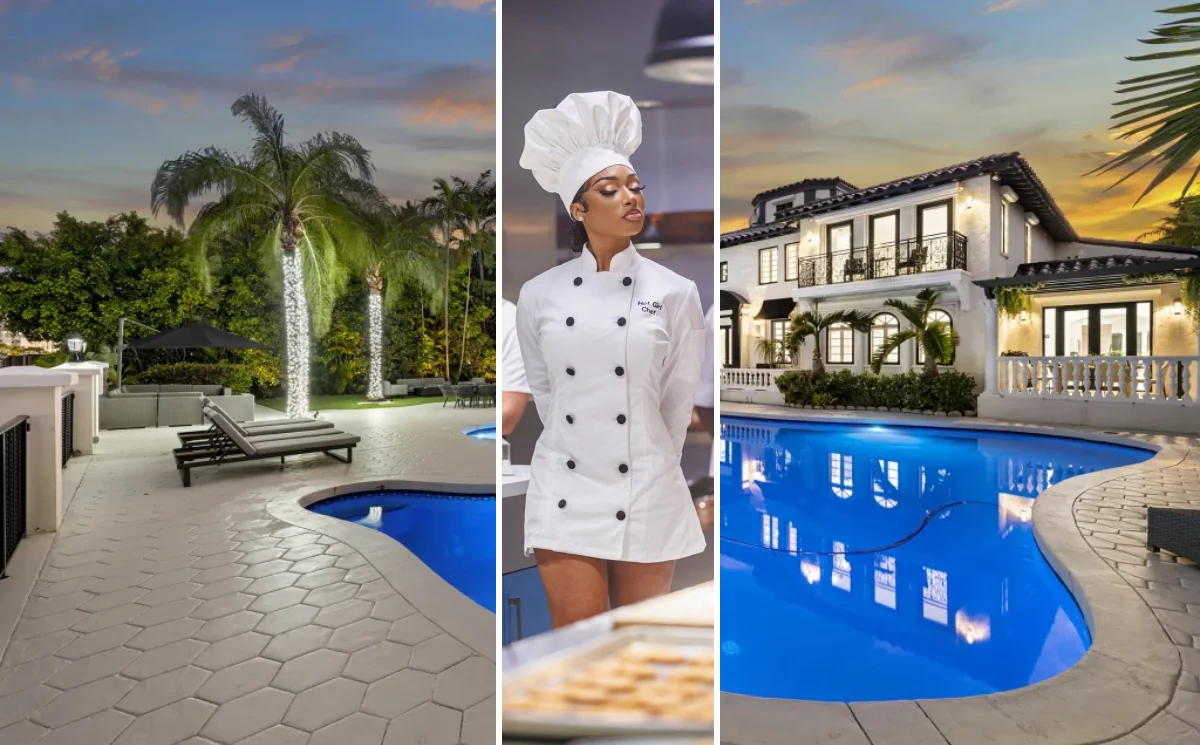
Megan Thee Stallion doesn’t do anything halfway — and her kitchen content proves it. The three-time Grammy winner, known for chart-toppers like Savage and Body, has built a genuine side persona around her cooking: “Thee Hot Girl Chef.” What started as Instagram recipe videos — Hot Cheeto elotes, flamin’ hot fried pickles — has grown into something larger. An NBC News food journalist spent weeks reverse-engineering her Thanksgiving cowboy beans recipe after she refused to reveal the secret ingredients, saying her “grandma would be in an uproar.” A Dunkin’ brand partnership leaned on her culinary credibility.
And in August 2025, she executive-produced KPopped, a cross-cultural music series on Apple TV+ that paired global icons with K-pop idols. Her kitchen, glimpsed through curated social media rather than full home tours, has become one of the more talked-about spaces in celebrity home content — though she keeps the full layout and location deliberately private.
What We Actually Know About Megan’s Kitchen
Unlike a lot of celebrity real estate coverage, most of what’s public about Megan’s kitchen comes from what she’s chosen to show in her own cooking content — Instagram reels, TikTok clips, and design outlets reacting to those clips — rather than from a formal home tour or listing. That distinction matters: many “facts” floating around online about her home (exact price tags, specific appliance brands, room-by-room layouts) trace back to speculative fan and content-mill posts rather than confirmed sources. Here’s what’s actually documented.
The Cabinets and Pantry That Got Design Press Attention
Megan shared a Hot Cheeto elotes recipe video on Instagram that drew as much attention for the kitchen itself as for the food. Homes & Gardens covered the moment specifically because of her wall-length built-in cabinets and floor-to-ceiling glass shelving displaying a curated glassware collection — plus a standout glass-paneled pantry that design professionals singled out as an unusually generous storage setup for a home kitchen.
San Diego-based interior designer Kristyn Harvey praised the supersize approach: “Pantries are not just for storing dried goods anymore but they also allow you to hide your appliances, cleaning products for the kitchen, dog food, serving trays you only use on the holidays, seasonal kitchen decor, and more.” Harvey also recommended textured glass cabinet doors over clear glass, noting they “provide you with the airy aesthetic of clear glass but the ability to still hide the mess behind the doors.”
Stephen Robinson, storage expert and founder of Only Oak Furniture, added that supersized pantry storage “can be extremely useful as a method to increase your storage capacity” and helps with bulk purchasing and meal prepping, though he cautioned that large pantries “require a decent amount of maintenance to keep them organized and clean” and warned against “over-shopping, hoarding, and potential food waste.”
A Kitchen Built Around an Actual Cooking Habit — Not Just a Backdrop
What separates Megan’s kitchen from a lot of celebrity spaces is that it’s clearly in regular use. She’s posted herself making Hot Cheeto elotes, flamin’ hot fried pickles, and — more recently — a full Thanksgiving spread for boyfriend Klay Thompson’s family. She’s also shared a compilation of herself repeatedly making him catfish and spaghetti, a dish Thompson has called his favorite. In a Facebook video that went viral, Thompson and his father watched her cook a meal together, with both reportedly telling her she “needs to be a chef”.
The Recipes That Made Megan a Food Culture Moment
Megan’s kitchen content has moved beyond casual Instagram reels into territory that drives real food journalism. Here are the dishes that defined her cooking identity.
Cowboy Beans
The dish that arguably crossed Megan from “celebrity who cooks” into “food culture figure” was her Thanksgiving cowboy beans. When she posted the recipe video, an NBC News journalist noticed the dish — red pepper, green pepper, onions, ground beef, and sausage in a sauté pan — and became obsessed with cracking the recipe. Megan wouldn’t share it: “I can’t just be giving out my secret recipes now. My grandma would be in an uproar,” she said, offering only that “it’s packed with lots of meat, lots of vegetables.”
The journalist’s research traced the dish’s roots to 19th-century cattle drives, where cowboys stewed dried pinto beans, bacon, onions, and spices in cast-iron pots. Those cowboys, in turn, borrowed the concept from Mexican vaqueros, whose original version — frijoles charros — was a more soup-like preparation with far less meat. After weeks of recipe testing involving multiple batches, secret-ingredient auditions (liquid smoke, maple syrup, French onion soup mix, molasses), and consultations with cookbook author Allison Robicelli, the journalist landed on a version built with andouille sausage, oregano, bacon, Dijon, and baked beans that “tasted like ‘Savage’ sounds.” Megan later posted the dish again, this time cooking it for Thompson’s father during a visit to the couple’s home.
A recipe table summarizing the key components of Megan’s cowboy beans:
| Component | Details |
|---|---|
| Base | Canned baked beans |
| Meats | Ground beef, sausage (andouille recommended for kick), bacon |
| Vegetables | Red pepper, green pepper, onions |
| Seasonings | Oregano, Dijon mustard, liquid smoke |
| Sweetener | Molasses (for depth without sweetness overload) |
| Cultural origin | Texas cowboy beans, rooted in Mexican frijoles charros |
Hot Cheeto Elotes and Flamin’ Hot Fried Pickles
These two recipes are what first brought Megan’s kitchen content widespread attention. Her Hot Cheeto elotes recipe — corn dressed with crushed Hot Cheetos, mayo, cotija cheese, and chili — went viral partly because of the kitchen backdrop visible in the video, which is what first caught design press attention. Her Flamin’ Hot Cheetos fried pickles video followed: she walked viewers through crushing the Cheetos into a breading, dipping pickles in egg and flour, coating them, and frying — delivered in her signature unfiltered commentary. Fans and outlets alike floated the idea that she should get her own cooking show. More recently, she’s also introduced a Flamin’ Hot Dill Pickle Cheetos collaboration, further cementing the crossover between her cooking identity and snack-food culture.
Catfish and Spaghetti
The dish Megan returns to most often in her relationship content is catfish and spaghetti — a pairing rooted in Southern and specifically Houston food culture. She’s shared a compilation of herself making it repeatedly for Thompson, who has called it his favorite meal. The dish reflects a broader pattern in her cooking: comfort food with Texas roots, made for the people she cares about rather than for camera aesthetics.
“Thee Hot Girl Chef” — How a Cooking Persona Becomes a Brand
What’s notable about Megan’s kitchen content is how organically it has expanded into a legitimate brand extension — not through a cookbook deal or a reality show contract, but through a consistent, self-directed cooking identity that started on social media and scaled outward.
From Instagram to a Dunkin’ Jingle
Megan’s regular posting of cooking tutorials and restaurant reviews built enough credibility in the food space that Dunkin’ tapped her to record a branded jingle — a collaboration that made sense precisely because her food persona felt authentic rather than manufactured. The partnership demonstrated something important: in an era where every celebrity has a “lifestyle brand,” Megan’s cooking identity actually moves the needle commercially because it predates and exists independently of any single deal.
KPopped
In August 2025, Apple TV+ premiered KPopped, a cross-cultural music competition series that Megan executive-produced. The show paired global music icons — including Patti LaBelle, Kylie Minogue, members of the Spice Girls, Boy George, TLC, and Vanilla Ice — with K-pop groups for reimagined song battles. Megan herself performed a K-pop version of Savage on the show and took on occasional hosting duties. PSY of “Gangnam Style” fame was billed as co-host.
The show, produced in partnership with Korean entertainment powerhouse CJ ENM, wasn’t universally praised — some critics called it “harmless but also largely vibeless” and “a fairly blatant attempt to cash in on the ubiquity of K-pop” — but the moments that worked were the chaotic ones: Boy George attempting to sing in Korean, Vanilla Ice reverting to his original 1990 dance routine for “Ice Ice Baby,” and Boyz II Men delivering a version of “End of the Road” that critics called “truly a delight”.
What matters for Megan’s brand trajectory is the connective tissue: KPopped is a natural extension of the same curatorial instinct that drives her cooking content. She picks what she’s interested in, puts her name on it, and lets the audience decide. The leap from “posting Hot Cheeto elotes videos” to “executive-producing an Apple TV+ series” sounds dramatic, but it’s the same energy — someone who treats personal taste as a creative direction.
How Megan’s Kitchen Compares to Other Celebrity Cooking Content
Celebrity kitchens tend to fall into two categories. Here’s how Megan’s approach stacks up:
| Category | Typical Celebrity Approach | Megan’s Approach |
|---|---|---|
| Space design | Cold, showroom-perfect, looks unused | Warm, storage-heavy, clearly lived-in |
| Content style | Polished home tours, curated reveals | Unfiltered cooking videos with personality |
| Food type | Chef-curated, aspirational | Comfort food, Houston-rooted, made for loved ones |
| Authenticity signal | Often staged, recipe-less | Documented cooking routine, specific recipes |
| Brand extension | Cookbook or product line | Cooking persona that organically expands into entertainment and brand deals |
For comparison, Ayesha Curry — wife of NBA star Steph Curry — built a similar trajectory: a genuine cooking identity that started with personal blogging and social media cooking videos, which led to a cookbook (The Seasoned Life), a TV show (Cookin’ With The Currys), and a massive social media following built around the idea of an NBA wife who genuinely loves food. Curry has spoken about how “everyone always gravitated toward the food” when she started blogging about faith and family, which eventually became her career. Megan’s version is louder, more unapologetically Houston, and built for a different audience — but the structural playbook is similar.
That said, without a full verified home tour, direct room-by-room comparisons should be read as impressionistic rather than factual.
What the Kitchen Content Reveals About Megan’s Life
Celebrity homes are carefully managed from a PR perspective, and Megan is notably guarded about her actual property details. Multiple outlets have noted she shares curated glimpses — a recipe video, a favorite angle — rather than comprehensive walkthroughs, in part for security reasons. Still, the cooking content itself is harder to fully stage, and it points to someone who treats cooking as a genuine hobby.
Her Houston upbringing shows up clearly in what she cooks: catfish and spaghetti, Hot Cheeto elotes, cowboy beans with roots in Texas cattle-drive history, and soul-food-leaning holiday spreads. That Southern comfort-food sensibility has stayed consistent even as her career and her homes have expanded from Houston to Los Angeles.
The recurring pattern — cooking for Klay Thompson, hosting Thanksgiving for his family, making cowboy beans for his father’s visits — paints a picture of someone for whom feeding people is a form of connection, not content strategy. Thompson’s father telling her she could “easily own her own restaurant” isn’t the kind of compliment you stage for Instagram. It’s the kind that happens in a kitchen that’s actually being used.
The Property Value Question — What We Know and Don’t Know
From a real estate perspective, a well-appointed kitchen is consistently one of the most value-adding rooms in any home, and celebrity provenance can add a premium. But specific dollar figures circulating online for Megan’s kitchen renovation or total home price vary widely — some point to a Houston property reportedly valued around $931,000, others to a Los Angeles property reportedly purchased for around $2.4 million in 2020. Given that inconsistency, and that Megan has owned more than one property, any single figure should be treated as unconfirmed without a primary source (a listing, deed record, or her own statement).
What design professionals can speak to is the kitchen’s features. The wall-length built-in cabinets, floor-to-ceiling glass shelving, and glass-paneled pantry that drew Homes & Gardens’ attention represent a significant investment in storage infrastructure — the kind of built-out that, in professional estimates, would represent a substantial renovation even before accounting for appliances, countertops, and finishes. But without Megan confirming specifics, exact numbers remain speculative.
Conclusion
Megan Thee Stallion’s kitchen content tells you things her music videos don’t — that “Thee Hot Girl Chef” is a real identity, not a bit. The glass-paneled pantry design press picked up on, the cowboy beans recipe an NBC News journalist spent weeks trying to crack, the catfish-and-spaghetti dinners Klay Thompson calls his favorite, and now an Apple TV production role that extends her food persona into entertainment — the throughline is someone who cooks because she actually likes it.
What we still don’t have is a fully verified picture of the space itself: exact costs, specific appliance brands, or a complete layout. That gap, combined with the richness of what she does show, is actually the point. Megan controls the narrative — you get the food, the personality, and the cultural connection, but the property details stay hers.
