
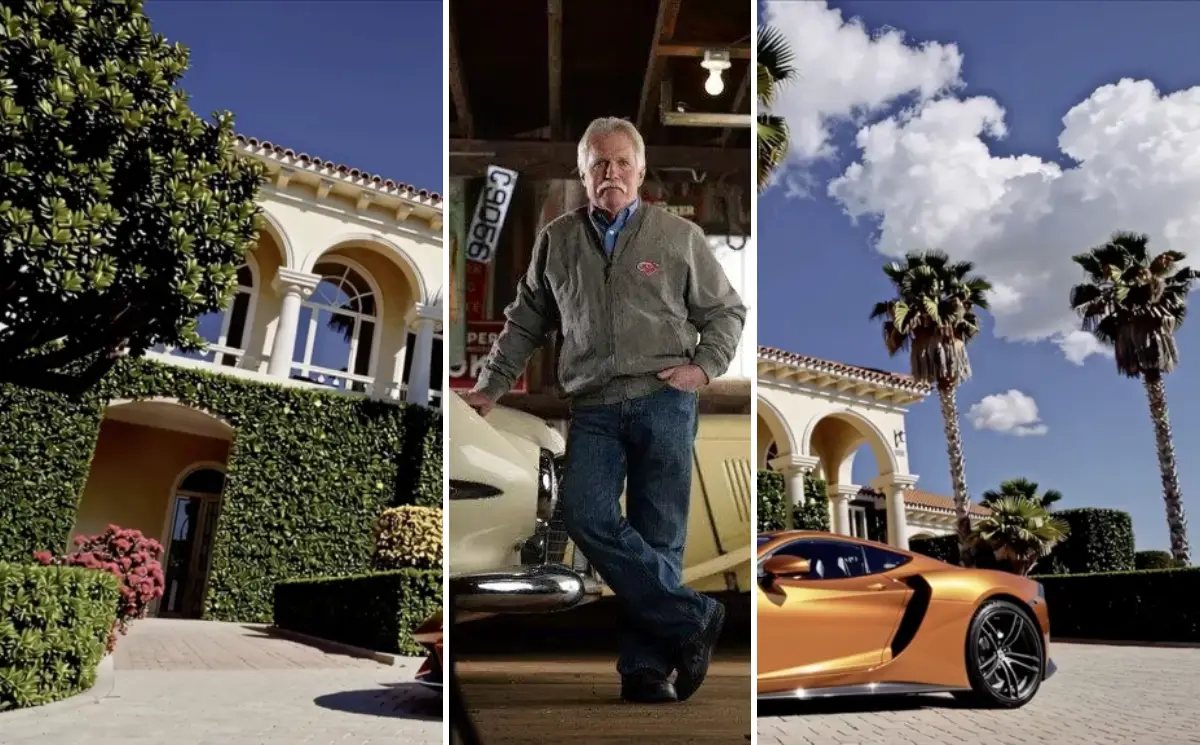
Wayne Carini has spent decades surrounded by some of the rarest automobiles on the planet. As the face of Chasing Classic Cars and the hands behind F40 Motorsports, he’s built a career on finding, restoring, and selling machines most people only see in magazines. But the question fans keep asking isn’t about a Ferrari or a Shelby — it’s about the Wayne Carini house.
What does a home look like when the man who owns it lives and breathes classic cars?
Who Is Wayne Carini?
Before getting into the house itself, a bit of context helps. Carini grew up in Portland, Connecticut, learning the trade from his father, Bob Carini, who ran a local body shop. That early education in paint, bodywork, and mechanical precision shaped everything that came after — from his career as a restoration specialist to his work as a dealer handling seven- and eight-figure automobiles.
His passion for cars started early, working alongside his father on classics including Duesenbergs, Lincolns, Packards, and Ford Model As. He also developed a lifelong interest in Ferrari after experiencing a 1960 Ferrari 250 SWB as a child.
Over the years, Carini’s expertise expanded into Ferrari restoration and the broader collector-car world. He learned the craft from experienced figures including Francois Sicard, a former Ferrari racing mechanic, and Luigi Chinetti Jr., whose family has deep ties to Ferrari’s early history in the United States.
His television show, Chasing Classic Cars, ran on Velocity (now MotorTrend) and gave viewers an inside look at the hunt for forgotten barn finds, high-stakes auctions, and meticulous restorations. Meanwhile, his shop, F40 Motorsports, operates out of Portland as a full-service facility for buying, selling, and servicing collector vehicles. It’s not a showroom built for Instagram — it’s a working shop with real grease on the floor.
The Wayne Carini House: Location and Property
The Wayne Carini house sits on roughly 13 acres in Portland, Connecticut — the same town where he grew up and still runs his business. Locals sometimes refer to the property as the “Portland Estate,” though that label carries a grandeur that doesn’t quite match the place itself. This isn’t a gated mansion with columns and a fountain. It’s a large, private property in a quiet corner of central Connecticut, surrounded by woods and rolling countryside.
Portland sits in Middlesex County, along the Connecticut River, and the town has a population of just under 10,000. It’s the kind of place where neighbors know each other but don’t pry. For someone like Carini — a public figure who clearly values his off-camera life — the setting makes sense. He’s close enough to F40 Motorsports to get to the shop in minutes, but far enough from any busy road that you wouldn’t stumble onto his property by accident.
More broadly, the property reflects Carini’s connection to rural Connecticut. His home, businesses, restoration work, and long-standing involvement in the collector-car community are all tied to the same part of the state.
A Handcrafted Log Home
The home itself is a handcrafted log house, reportedly built by Carini in the early 1990s [VERIFY: exact construction date and whether Carini personally built it]. Log homes aren’t unusual in rural New England, but this one carries a particular warmth that fits the owner. The woodwork — heavy timber framing, exposed beams, and natural grain — reflects the same hands-on approach Carini brings to his car restorations. Nothing prefab. Nothing rushed.
Inside, the design favors open spaces, natural light, and warm tones. Large windows face the surrounding countryside, pulling in views of the property’s trees and open ground. The interior palette leans on rich wood, neutral fabrics, and earth-toned accents. It feels lived-in rather than staged — a home built for comfort, not for magazine shoots.
The layout separates living quarters from the more automotive-focused parts of the property, though the two worlds inevitably overlap. You don’t walk through the front door without seeing signs of what the owner does for a living.
Inside the Wayne Carini House: Automotive Memorabilia Meets Everyday Living

The interior reads like a love letter to automotive history — but one that’s been folded into a real, functioning home rather than a museum.
Walls display vintage car posters, framed photographs from decades of auctions and restorations, and rare pieces of automotive art. In some rooms, you’ll spot old engine parts repurposed as decorative objects or shelves built from reclaimed shop materials. These aren’t cheap reproductions ordered online. They’re artifacts from a career that’s spanned some of the most significant eras in car collecting.
Carini’s personal office deserves special mention. It doubles as a small archive — rare documents, period photographs, reference books, and memorabilia from landmark deals he’s brokered over the years. For anyone who’s watched even a few episodes of Chasing Classic Cars, the space will feel familiar: organized chaos, with history tucked into every corner.
The main living areas, by contrast, are designed for family. Plush seating, well-chosen lighting, and custom shelving create rooms that feel comfortable rather than cluttered. The kitchen and dining areas are set up for gatherings — the kind of spaces where you’d linger over dinner and swap stories about cars you’ve owned, lost, or wished you’d never sold.
The Garage: Wayne Carini’s Real Living Room
If the house is where Carini sleeps, the garage is where he actually lives. The on-property garage facility is purpose-built to house, maintain, and work on collector-grade vehicles. We’re talking climate control, security systems, hydraulic lifts, and enough floor space to move around cars without risking a scratch on a $500,000 fender.
This isn’t just parking. The garage functions as a fully equipped workshop where Carini and his team handle restoration and maintenance work. Tools are meticulously organized. Lighting is bright and even — critical when you’re doing paint correction on a car worth more than most houses. The setup includes quality equipment like Advantage Lifts, which allow safe storage and access to vehicles at multiple levels.
The setup also makes sense in the context of Carini’s wider automotive businesses. His professional work has involved everything from collision repair and restoration to buying and selling significant collector automobiles.
Cars Associated with Wayne Carini
Carini has handled hundreds of significant cars through F40 Motorsports and his television work. Some of the vehicles most commonly associated with him include:
- 1961 Ferrari 250 GT SWB — One of the most celebrated Ferraris ever built, with racing heritage and a price tag well into eight figures.
- 1932 Ford Hot Rod — A foundational piece of American car culture, and a model Carini has worked with many times.
- Bugatti Type 57SC Atlantic Replica — A tribute to what many consider the most beautiful car ever designed.
- Porsche 356 Speedster — A mid-century icon whose influence on sports car design is still felt today.
- Shelby Cobra 427 — Raw American power in its purest form.
- Volkswagen ID.Buzz [VERIFY: confirm this is in Carini’s personal collection] — A modern electric van with retro styling, showing Carini’s willingness to embrace new technology alongside old favorites.
It’s worth noting that many of the most spectacular cars viewers see on Chasing Classic Cars pass through Carini’s hands but belong to clients, not to him personally.
His own collection is more curated and personal — less about investment value and more about the machines that mean something to him. He has also been associated with an appreciation for original and unrestored automobiles, reflecting the preservation side of the collector-car hobby rather than an approach focused solely on returning every vehicle to showroom condition.
Family Life Behind the Scenes
For all the automotive talk, the house is a family home first. Carini shares the property with his wife [VERIFY: wife’s name — some sources say Laura, but this is not widely confirmed] and their family. The home includes dedicated spaces for downtime — reading areas, a home theater, and outdoor recreation that have nothing to do with cars.
His family life has also influenced his involvement beyond the restoration business. Carini has supported autism-related organizations and automotive events connected with special-needs communities, making that part of his life separate from the commercial side of collecting and restoration.
Social media glimpses show Carini occasionally taking restored vehicles out for drives on and around the property, sometimes with family members riding along. It’s a small detail, but it tells you something about the man: the cars aren’t just business assets. They’re part of how he connects with the people closest to him.
Outdoor Spaces and Grounds
The 13-acre property gives Carini room to breathe — and room to play. Manicured gardens, native plantings, and stone pathways create a landscape that feels intentional without being fussy. A patio area provides space for entertaining, and the property’s long driveway serves as more than just a way in and out. On a property like this, pulling a classic car up the drive is its own kind of event.
Scattered throughout the grounds, you’ll find automotive-themed touches — vintage signage, small sculptures, and decorative elements that nod to Carini’s profession without turning the yard into a theme park. The outdoor spaces feel like a natural extension of the house: personal, relaxed, and unmistakably his.
Security and Privacy
Owning a property filled with rare and valuable automobiles demands serious security. The Wayne Carini house is equipped with surveillance systems, controlled access points, and secure fencing designed to protect both the family and the collection. Given that a single car in the garage could be worth upward of a million dollars, these measures aren’t optional — they’re essential.
Carini has also been deliberate about keeping his private life out of the public eye. Despite years on television, he doesn’t overshare. You won’t find his home featured in real estate listings or architectural spreads. The occasional glimpse on his show or in an interview is about as much as the public gets, and that appears to be exactly how he wants it.
How Does Wayne Carini’s House Compare to Other Collectors’ Homes?
Among major car collectors, homes tend to fall into two camps: the mega-garage complexes built as much for public display as for personal use, and the private retreats where the collection serves the owner rather than the other way around. Carini’s property firmly belongs in the second category.
The most obvious comparison is Jay Leno’s Big Dog Garage in Burbank, California — a facility that’s practically a museum, designed for media production and large-scale events. Leno’s space is spectacular, but it’s built for an audience. Carini’s is built for himself.
| Feature | Wayne Carini’s Property | Jay Leno’s Big Dog Garage |
|---|---|---|
| Location | Portland, Connecticut | Burbank, California |
| Property Size | ~13 acres | Multiple buildings on a large campus |
| Architecture | Handcrafted log home | Industrial-style garage complex |
| Primary Purpose | Private residence with car storage | Showcase, media production, and storage |
| Atmosphere | Rustic, family-oriented | Museum-like, event-ready |
| Garage Setup | Working shop with restoration space | Display-ready with media facilities |
Other collectors — Ralph Lauren, Jerry Seinfeld, and Chip Connor — have built similarly impressive garages, but almost all of them lean toward the gallery or museum model. Carini’s approach is refreshingly different. His garage is a workplace. His home is a home. The two coexist without either one pretending to be something it’s not.
Conclusion
The thing that stands out about the Wayne Carini house isn’t any single feature — not the log construction, not the garage, not the acreage. It’s the coherence of it all. Every part of the property reflects someone who builds things with his hands, values quality over flash, and treats his collection as an extension of his life rather than a trophy case.
For fans of Chasing Classic Cars and classic car culture in general, Carini’s home offers something rare: a glimpse of what a real collector’s life looks like when it’s driven by passion instead of performance. The house, the garage, the grounds — they all belong to someone who genuinely loves the work. And that, more than any single car in the collection, is what makes the place worth knowing about.
