

Eric Schmidt doesn’t buy houses the way most wealthy people do — one home, maybe two, a city base and a vacation retreat. The former Google CEO, now leading aerospace company Relativity Space, and his wife Wendy have quietly assembled one of the most extraordinary real estate portfolios in America. We’re talking properties estimated at over half a billion dollars, stretching from a château in Holmby Hills to a Victorian mansion in West London, with a Versailles-inspired estate on the Hudson River thrown in for good measure.
Every Eric Schmidt house tells a story. Some are about architectural preservation. Others are about investment strategy. A few seem driven by nothing more than genuine passion. Taken together, they paint a picture of how tech wealth is being converted into historically significant, tangible assets on a global scale.
The $110 Million Headline: Spelling Manor
The biggest splash came in 2025 when the Schmidts paid $110 million for the Manor — the French chateau-style mega-mansion on Mapleton Drive in Holmby Hills, built around 1990 for television producer Aaron Spelling.
The property is slightly larger than the White House. It has a bowling alley, a wine cellar, and a beauty salon with massage and tanning rooms. It had lingered on the market for years, listed at $137.5 million and suffering multiple price cuts before the Schmidts stepped in at a relative discount.
Here’s the twist: they aren’t moving in. The couple plans to use the property — now simply called “594,” after its address — primarily to host meetings and events for Los Angeles nonprofits and cultural institutions. They’ve already partnered with the Museum of Contemporary Art on the Eric and Wendy Schmidt Environment and Art Prize. A significant remodel is planned to simplify the floor plan and maximize energy efficiency.
The Manor had its own drama before the sale. A group of scammers executed a phony deed on the property in 2024 and recorded it with Los Angeles County, forcing the seller into a months-long legal battle to clear the title. The Schmidts bought it anyway.
Astor Courts: A Gilded Age Masterpiece on the Hudson
If the Spelling Manor is the biggest number in the portfolio, Astor Courts is the best story.
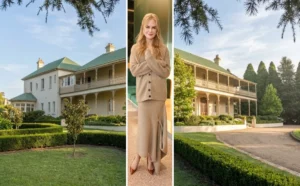
This 40,000-square-foot Beaux-Arts mansion sits along the Hudson River in Rhinebeck, New York. Stanford White designed it in 1902 for John Jacob Astor IV — the Gilded Age magnate who would die aboard the Titanic a decade later. White modeled the estate after the Grand Trianon at Versailles, creating an opulent guesthouse and sporting pavilion with indoor tennis courts and sweeping river views.
The property has lived many lives. After Astor’s widow Brooke became one of New York’s most prominent socialites, she donated the estate to the Catholic Archdiocese of New York. It passed through several owners, fell into disrepair, and went through multiple incomplete renovation attempts before the Schmidts purchased it in early 2016 for $9.4 million.
What followed was a restoration done right. They hired Samuel White — Stanford White’s great-grandson and a founding partner at PBDW Architects — as the architect. Interior designer Gary McBournie, who’d worked on several of the Schmidts’ other properties, took charge of the interiors.
The level of detail is remarkable. McBournie and Wendy Schmidt traveled to auction houses in Paris, London, and New York to source period-appropriate furnishings, including Regency rosewood cabinets, Louis XV armchairs, and 19th-century Italian chandeliers. Original wood panels, parquetry, marble, and intricate ceiling moldings were carefully repaired or replicated. A custom de Gournay wallpaper depicting scenes of the Hudson Valley — hand-painted over many months — now fills a large foyer leading to the bedrooms.
The property’s systems were modernized too. The original coal-powered electricity and heating were replaced with renewable geothermal energy, a detail that reflects the Schmidts’ broader interest in environmental sustainability.
“Eric and I love taking on the restoration of historic properties as a kind of shared hobby, to bring them back to life and to prepare them for the next century,” Wendy Schmidt told Architectural Digest.
Astor Courts had already earned preservation accolades before the Schmidts arrived. In 2009, it received an Excellence in Preservation Award from the Preservation League of New York State for earlier restoration work that stripped away inappropriate alterations and reopened views of the river.
Crossing the Atlantic: London’s Holland Park
In 2025, Schmidt expanded internationally with the purchase of a double-fronted Victorian mansion in London’s Holland Park for £42 million — roughly $55 million at the time.
The acquisition places him among a growing wave of wealthy American buyers reshaping London’s super-prime property market. North Americans invested more than Europeans in British property in 2022, pumping in £40 billion compared to £30.5 billion from European buyers, according to real estate firm Savills. That trend has only accelerated since, with estate agents reporting a noticeable uptick in American demand following the 2024 presidential election.
Schmidt plans to rent the property out rather than live there, a smart play given that demand for high-quality short-term rentals in prime central London is running high. Super-prime property values remain significantly below their 2014 peak, making the current market particularly attractive for long-term investors.
The California Collection
Schmidt’s ties to California run deep — he led Google from its Mountain View headquarters for over a decade — and his holdings in the state reflect both personal history and investment savvy.
Montecito
The Schmidts own a Mediterranean-style estate originally built in 1926 by architect George Washington Smith. The Spanish Colonial Revival home spans nearly 6,000 square feet with five bedrooms, set on four acres of gardens, walking paths, a tennis court, and a pool. Schmidt bought it in 2006 for $20 million from Ellen DeGeneres and Portia de Rossi. The property later gained pop-culture fame as the venue for Kim Kardashian and Kris Humphries’s 2011 wedding.
Holmby Hills Château
Before the Spelling Manor, Schmidt already owned a 9,182-square-foot French château-style home in the neighborhood, purchased in 2014 for $23.25 million. Built in 1932, it was once owned by the family of actor Gregory Peck and features seven bedrooms, nine bathrooms, and an elevator. The guest list over the decades reads like a Hollywood who’s-who: Audrey Hepburn, Cary Grant, Michael Jackson, George Clooney.
Yellowstone Club, Montana
For skiing season, there’s a 9,040-square-foot home inside the Yellowstone Club — the world’s only fully private ski and golf community, with members like Bill Gates and Mark Zuckerberg. The club offers 2,700 acres of ski terrain and over 100 trails, all behind a membership wall that requires home ownership and steep annual fees. Schmidt hosts a summit there every summer.
Atherton (Sold)
The Schmidts recently let go of their longtime Silicon Valley base, selling the three-acre Atherton compound for $22.5 million after more than three decades of ownership. Starting with a 5,265-square-foot main house purchased in 1990, they expanded the property over 20-plus years to include a guesthouse, extensive gardens, and a rare greenhouse imported from the United Kingdom.
Filling in the Map: San Francisco, D.C., Nantucket, and Beyond
The portfolio doesn’t stop at the marquee addresses. In 2025, the Schmidts paid $24 million for a top-floor apartment in a historic Beaux-Arts co-op in San Francisco’s Pacific Heights.
In Washington, D.C., they acquired the Newton B. Baker House in Georgetown in late 2023 — a property with deep historical resonance as Jacqueline Kennedy’s residence in the year following President Kennedy’s assassination.
Nantucket holds a special place in the couple’s history. Over the years, they’ve built a significant presence on the Massachusetts island that has included a sprawling shingled compound styled as a cluster of coastal cottages, homes along Old North Wharf, and a private deep-water dock.
They also maintain properties in Miami Beach and New York City, bringing the total count to addresses on at least three continents.
When he’s not at any of his homes, Schmidt is often aboard his 312-foot yacht, Whisper — reportedly acquired for $158 million in 2023 — or crisscrossing continents in his Gulfstream G650ER jet.
The Strategy Behind the Empire
This isn’t trophy buying on autopilot. Schmidt’s spokesman told the Financial Times that “Eric invests in high-end real estate properties around the world,” and the pattern bears that out.
He gravitates toward properties with architectural significance, historical provenance, and prime locations — assets that tend to hold their value even in turbulent markets. Research supports this approach: protected historic buildings have shown greater rates of property appreciation than those in unprotected neighborhoods and tend to be more resilient during downturns.
Global diversification matters too. Spreading holdings across U.S. cities, a Montana resort community, and international markets like London reduces exposure to any single real estate cycle. And at the ultra-high end, properties like the Spelling Manor and Holland Park mansion function almost like fine art — scarce, culturally significant assets that the world’s wealthiest buyers compete for.
Then there’s the personal dimension. Wendy Schmidt has spoken openly about their shared passion for architectural restoration, and the decision to convert the Spelling Manor into a nonprofit event space suggests motivations beyond the financial. These are people who genuinely care about buildings.
Final Thoughts
With an estimated net worth exceeding $30 billion, Eric Schmidt’s real estate holdings represent a relatively modest slice of his overall wealth. But the portfolio carries outsized significance.
It shows how Silicon Valley fortunes are being parked in physical, historically rich assets — not just stocks and startups. It reflects a bet on legacy over liquidity. And it demonstrates a model where personal taste, preservation ethics, and sharp investment instincts all reinforce each other.
From a Versailles-inspired mansion on the Hudson to a Victorian gem in West London to a mega-mansion in Holmby Hills rebranded as a cultural venue, each Eric Schmidt house is a deliberate choice. Not random luxury — a collection with a point of view.



2 thoughts on “Eric Schmidt House: Inside the Google Billionaire’s $200M Property Empire”
Comments are closed.