
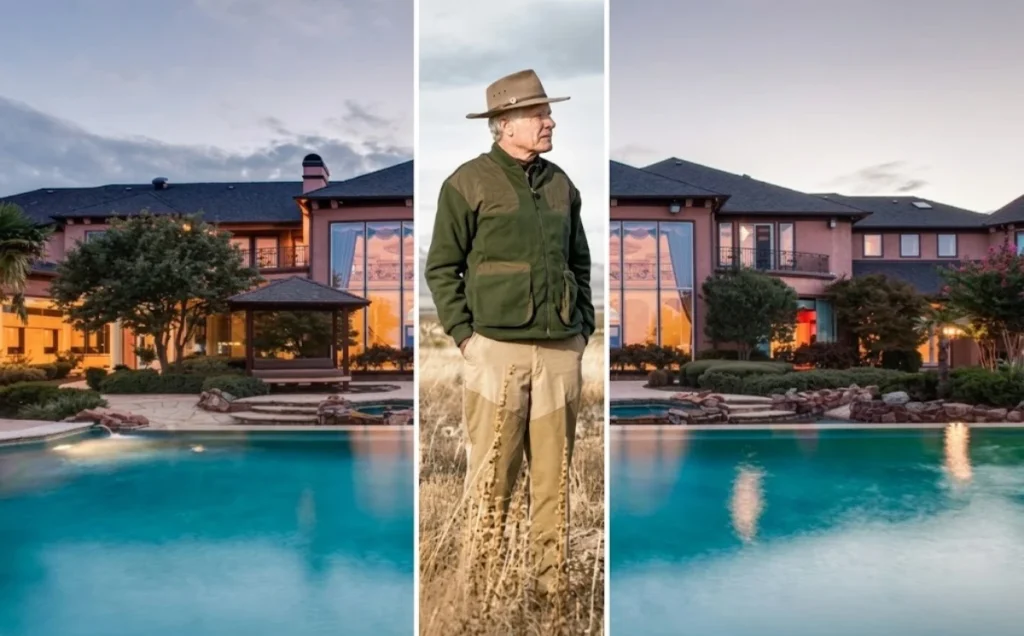
Ted Turner owns more private land than any other individual in America. We’re talking over 2 million acres. That’s bigger than Delaware and Rhode Island combined.
But here’s the thing — when people ask about “Ted Turner’s house,” they aren’t just asking about four walls and a roof. They’re asking about an entire empire of retreats, working ranches, and a sprawling legacy that changed Atlanta forever. From the CNN founder’s media revolution to the bison roaming his New Mexico property, this is a story about a man who built a life most of us can barely imagine.
So what’s it actually like inside Ted Turner’s world? Let’s take a look — no private jet required.
Ted Turner owned multiple residences across the United States. His primary homes included Avalon Plantation in Lamont, Florida (near Tallahassee), where he died on May 6, 2026; a modest 800-square-foot rooftop apartment above the old CNN Center in Atlanta, Georgia; Casa Grande, a 25,000-square-foot mansion on New Mexico’s Vermejo Park Ranch; the Flying D Ranch in Montana; and the Turner House on St. Phillips Island, South Carolina (near Beaufort).
Who Is Ted Turner, Really?
Here’s what surprises most people about Ted Turner. The media empire was just one chapter. His real passion these days? Dirt. Grass. Bison. Water. Trees. Turner became the largest private landowner in the United States, and unlike some billionaires who buy land for privacy or profit, his acquisitions were driven by conservation efforts to save it. His ranches aren’t status symbols. They’re working conservation projects. That’s not spin — the guy has spent hundreds of millions restoring habitats and bringing species back from the brink. —
Where Did Ted Turner Actually Live?
Ted Turner never had one “main house.” He lived across multiple properties, depending on where his work or conservation efforts took him. Here is a breakdown of his primary residences:
The CNN Center Apartment — Atlanta, Georgia
During his CNN years, Turner lived in an 800-square-foot rooftop apartment above the old CNN Center in downtown Atlanta. It featured 1980s-style decor and a massive saltwater fish-tank wall divider — a tiny, hands-on space he kept largely untouched so he could stay close to his newsroom. This was his primary Georgia residence and the place where he slept while building his media empire.
Avalon Plantation — Lamont, Florida (Near Tallahassee)
For years, Turner owned a plantation-style retreat called Avalon near Tallahassee, Florida — specifically in the small community of Lamont. This wasn’t one of his massive working ranches. It was quieter. More personal.
Avalon featured classic Southern architecture, surrounded by open fields and old oaks. Turner used it as an escape from the noise of Atlanta and the media business. Contrary to some rumors, Turner never sold Avalon. He owned it until his death. In fact, he passed away there on May 6, 2026. This 25,000-acre historic estate is also where he famously married Jane Fonda in 1991.
Casa Grande — Vermejo Park Ranch, New Mexico
Hidden within his massive Vermejo Park Ranch in New Mexico is Casa Grande, a sprawling, early 20th-century mission-style stone mansion built by industrialist William H. Bartlett. At roughly 25,000 square feet, this is Turner’s most palatial residence. It later functioned as a private family refuge and has since been converted into a luxury guest lodge where visitors can experience the beauty of the high desert.
Flying D Ranch — Montana
Then there’s the Flying D Ranch near Bozeman, Montana — around 113,000 acres of classic Big Sky country. This is where Turner ran one of the largest private bison operations in the world. The Flying D isn’t a single house — it’s a working ranch with multiple residences for staff, guests, and Turner himself. The main log home, which he decorated alongside Jane Fonda, embodies the rustic, land-first philosophy that defined his later years.
St. Phillips Island — South Carolina (Near Beaufort)
In 1979, Turner purchased St. Phillips Island, a 4,680-acre private barrier island off the coast of Beaufort, South Carolina. He built a 3,350-square-foot, 5-bedroom retreat there, known as The Turner House, which he used as a private family getaway. Today, the island is part of South Carolina’s state park system and the Turner House is available for public rental — starting at approximately $10,000 for a 5-night stay.
Where Are Ted Turner’s Ranches?
Beyond his personal residences, Turner’s ranch empire spanned multiple states. His total land holdings exceed 2 million acres across:
- Vermejo Park Ranch, New Mexico — 550,000 acres (home to Casa Grande)
- Flying D Ranch, Montana — 113,000 acres
- Ladder Ranch, New Mexico — 156,000 acres
- Sierra Grande Ranch, New Mexico — 18,000 acres
- Armendaris Ranch, New Mexico — 365,000 acres
You might wonder — what does one person do with 2 million acres?
Turner’s answer has always been the same: restore it, protect it, and share it.
His ranches aren’t gated playgrounds. Many of them operate as guest lodges and eco-tourism destinations. You can literally book a stay at Vermejo, one of the Ted Turner reserves dedicated to preserving natural beauty. I’ve talked to people who have been, and they all say the same thing — it feels less like a resort and more like stepping into a nature documentary.
Architecture and Design
Ted Turner’s houses don’t look like typical billionaire estates; they reflect his commitment to philanthropy and conservation. You won’t find gold-plated anything.
What you will find is a consistent design language across his properties:
- Natural stone and timber construction
- Expansive windows facing wild landscapes
- Simple, comfortable furnishings
- Western and Native American art
- Fireplaces everywhere
Architectural Digest has featured glimpses of his spaces over the years, and the takeaway is always the same: Turner builds homes that respect the land. He doesn’t import Italian marble or install crystal chandeliers. That’s not his thing.
Honestly? That restraint says more about his character than any CNN success ever could.
How CNN Transformed Atlanta
Before CNN, Atlanta was a regional Southern city with a good airport and Coca-Cola headquarters.
After CNN?
Atlanta became a global media capital. Turner Broadcasting brought thousands of jobs, international reporters, and a new kind of energy to downtown. The CNN Center became a landmark. Tourists came to see where the news was made. Young professionals moved to the city for media careers.
It’s hard to overstate how much Turner shaped modern Atlanta. He didn’t just build a company. He anchored an entire industry in the South.
The Conservation Mission: More Than Land
The Bison Comeback
Here’s a number that blew my mind. When Turner started, there were fewer than 1,000 wild bison left in North America.
Today, his ranches alone hold over 45,000 bison. That’s roughly the largest private herd on the planet.
And these aren’t just livestock. Turner’s bison are genetically pure in many cases, free of cattle DNA that contaminated most commercial herds. That genetic integrity matters for the species’ long-term survival.
What Can We Learn From Ted Turner’s Approach?
Turner’s houses and ranches teach us something interesting about wealth.
Most billionaires build bigger. They add square footage, infinity pools, private theaters. Turner went the opposite direction. He bought acres instead of architecture. He invested in ecosystems instead of amenities.
That’s why the question “What does Ted Turner’s house look like?” always feels incomplete. The honest answer is that his home is an entire landscape. The walls are mountains. The backyard is a bison range. The guest rooms are lodges where strangers can come stay and witness conservation in action.
And here’s the really interesting part — you can visit. Unlike most celebrity or billionaire properties, many Turner ranches welcome the public. You can book a room at Vermejo. Or you can fish, hike, and photograph wildlife. You can see what responsible land stewardship actually looks like.
Conclusion
Ted Turner’s house isn’t a single address. It’s a sprawling network of ranches, retreats, and working landscapes that together tell the story of a man who thought differently about wealth.
He built CNN and changed Atlanta forever. He bought 2 million acres and changed conservation forever. And he did it all while living in homes that served the land rather than dominating it, a principle central to the conservation efforts of Turner Enterprises. Whether it was the modest CNN Center apartment in Georgia, the historic Avalon Plantation in Lamont, Florida, the rustic Flying D in Montana, or the beachfront Turner House on St. Phillips Island in South Carolina, every property told a piece of his story.
If you ever get the chance to visit Vermejo, the Flying D, or even rent the Turner House on St. Phillips Island near Beaufort, take it. I know I plan to. The lodges are beautiful, sure — but what you’ll remember is the bison on the horizon and the quiet that only comes from miles of protected wilderness.
What do you think — would you rather have a mega-mansion or 2 million acres of wild land? I know my answer.

1 thought on “Ted Turner’s House: Inside the $2-Million-Acre Empire of the CNN Founder”