
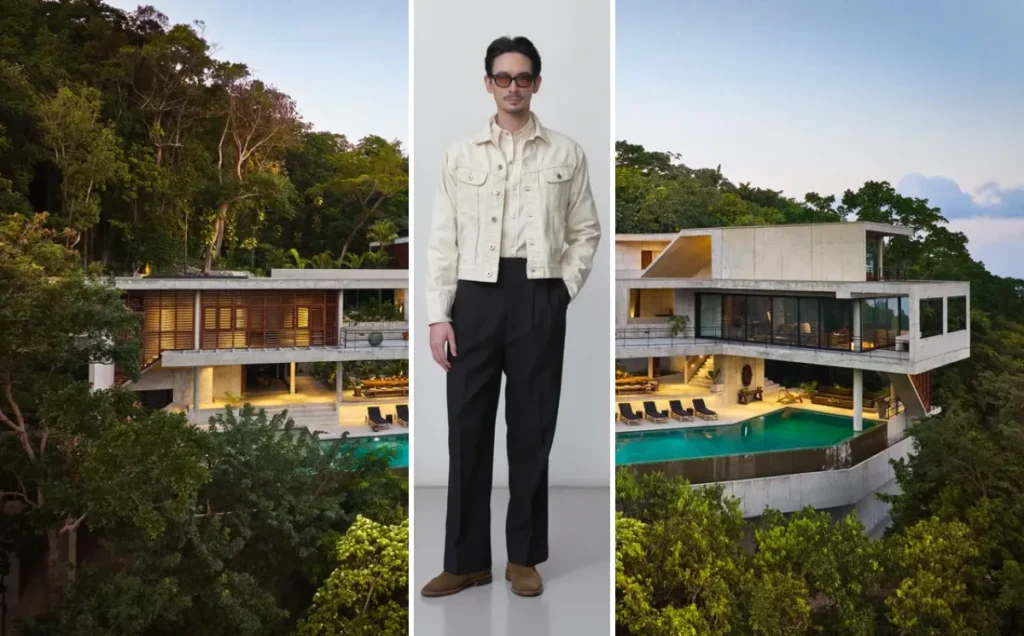
The Diplo Jamaica house is called Pompey, and it is less a private mansion than a working compound: a set of raw-concrete pavilions on a jungle estate in Portland Parish, on the island’s northeast coast, with a recording studio, a farm, stables and a wellness wing. Diplo, born Thomas Wesley Pentz, unveiled it in Architectural Digest‘s June 2024 issue. Within months it was also taking paying guests.
Pompey at a glance
Published acreage varies between sources: 50-plus acres in Galerie and Freecell’s descriptions, 62 acres in AD-based coverage and STIR.
How the Diplo Jamaica House Came Together
Diplo found the land, a hillside of farmland and jungle, about seven years before the house was finished, and worked on the vision over that period. He has credited Jamaica with much of his success, telling AD there is “magic here”, a link that runs through his work with Major Lazer and its dancehall roots. Some coverage of the AD feature describes the construction itself as taking about two years, so the seven-year figure is best read as the life of the project from purchase to completion.
Brutalist Architecture in a Rainforest
Freecell and Gia Wolff composed the house as a series of cast-concrete boxes stacked on and threaded through one another, raised and cantilevered over the slope. The designers point to three influences: Le Corbusier’s pilotis, Brazilian modernism, and the Sri Lankan architect Geoffrey Bawa’s way of letting buildings dissolve into gardens. Diplo told AD he loved the poured concrete and the Brazilian, brutalist look.
Rather than one big building, Pompey is a main house, guest quarters and a freestanding studio pavilion joined by bridges, trellises and breezeways, so moving around means going outdoors. Around 30,000 pounds of the area’s native honeycomb limestone was worked into the site, and Jamaican specialists Geoponika planted it with native orchids, ferns, bromeliads and palms. Solar panels supply heat and power, and rainwater catchment supplies water.
What is on the estate
Recording studio
A 2,000 sq ft pavilion with a live room, control room, its own living area and a bedroom.
Gym and recovery
Pilates reformer, boxing kit, climbing wall, hyperbaric chamber, sauna, cold plunge and a yoga pavilion.
Farm and stables
Banana, guava, coconut, avocado, jackfruit, pineapple and breadfruit; horses, goats, donkeys and 19 beehives.
Site-specific works
Pedro Reyes, Sofia Londoño, Veronica Ryan, Lucas Muñoz, Garnett Puett and Vince Skelly.
From Second Home to Bookable Retreat
By late summer 2024 Pompey was being marketed for private bookings through its own website, and Galerie reviewed it as a hotel that September. Coverage of the launch described in-house chefs, a heated infinity pool, horseback riding, a grand piano and bar, and studio time for visiting musicians, with Diplo promising artists the best sessions of their careers. Nightly rates have not been published.
The “$100 million” figure
Many posts call Pompey a $100 million mansion. No source has published what Diplo paid for the land, what the build cost or what the estate is worth, and no listing or appraisal exists. The number appears to be invented.
The Backlash in Jamaica
Not everyone welcomed the AD feature. Jamaican readers, as reported by DancehallMag in May 2024, asked why a house meant to celebrate the island leaned on Brazilian architecture, Mexican art and Japanese touches, and was designed by a New York firm rather than local architects, with few Jamaican artists represented. Others raised the familiar concern that foreign buyers of large rural estates push up land prices for Jamaicans. Some international commenters went further and called the project colonial, and revived past allegations against Diplo.
Diplo’s Other Homes
Pompey is a second home. In California, he paid $13.2 million for a Bali-style estate on 1.5 acres in Malibu’s Point Dume enclave, a 5-bedroom, 8,305-square-foot house once owned by Kid Rock. He also sold a Hollywood Hills house in 2021 after a bidding war.
Malibu has its own history of architect-led houses, from Edward Norton’s landmark home to Robert Downey Jr.’s Binishell house, which aims at the same mix of experimental form and self-sufficiency that Pompey chases in the Jamaican jungle.
Sources
- Galerie, “Hotel of the Week” (September 2024): design team, studio, amenities, farm, artists, bookings.
- STIR (October 2024): suites, honeycomb limestone, Geoponika, livestock and acreage.
- An Interior: the stacked-box design, influences, bridges and breezeways, solar and rainwater systems.
- DancehallMag (May 22, 2024) and DancehallMag (May 23, 2024): the AD feature, the backlash and Diplo’s comments on Jamaica.
- DoubleBlind (August 2024): the launch as a bookable retreat.
- Celebrity Net Worth: the $13.2 million Point Dume purchase.
- The Real Deal (March 2021): the Hollywood Hills sale.




1 thought on “Diplo Jamaica House: Inside Pompey, His Brutalist Portland Estate”
Comments are closed.