
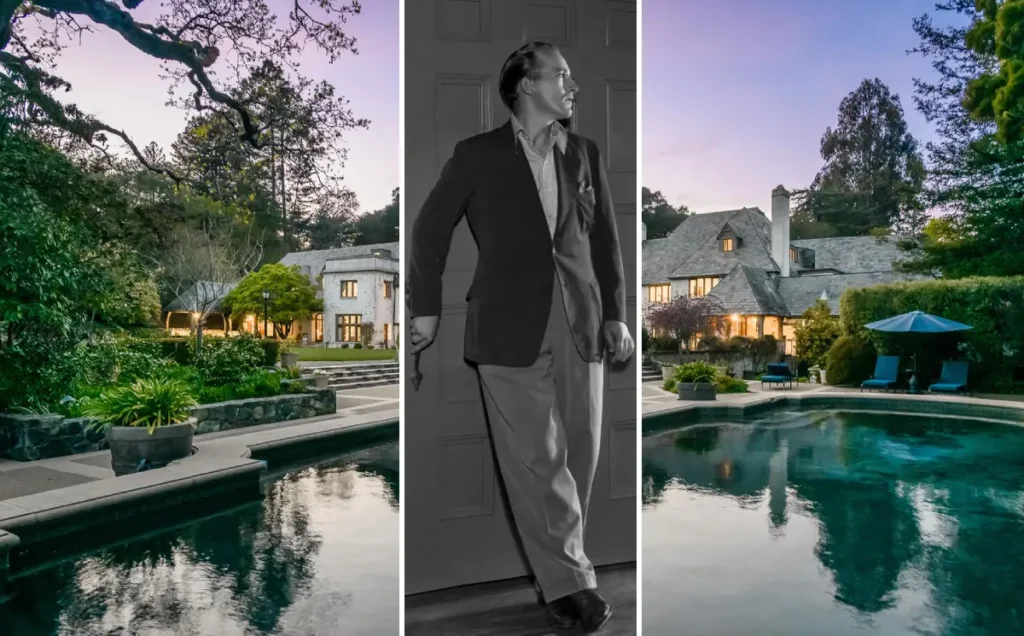
You know how some voices just feel like a warm blanket? That was Bing Crosby, a legendary figure in music and film. He was the guy your grandparents swooned over, the smooth baritone behind “White Christmas,” and arguably the first true multimedia superstar.
But have you ever wondered where a guy like that kicks off his shoes after crooning to millions? Or where he grew up in the first place?
Bing Crosby’s story is really told through three houses: the modest Spokane home where he became “Bing,” the grand Hillsborough estate where he raised his family, and the Rancho Mirage retreat where he played. Let’s take a walk through all three.
The Man Behind the Mic: More Than Just a Crooner
Before we get to the real estate, we have to talk about the scale of this guy’s fame. Honestly, it’s hard to overstate it.
Harry Lillis Crosby was born in Tacoma, Washington, in 1903 and grew up in Spokane. As a kid, he picked up the nickname “Bingo” from a neighbor who shared his love of a comic strip called The Bingville Bugle — it eventually got shortened to “Bing,” and it stuck for life.
Bing wasn’t just a singer. He was the singer. Between 1927 and 1962, he scored 368 charted records under his own name and 38 number-one hits — more than the Beatles or Elvis ever managed. He recorded “White Christmas,” the best-selling single in history. But he was also a shockingly good actor: he appeared in over 100 films and won the Academy Award for Best Actor in 1944 for Going My Way.
So you’ve got a guy who dominates radio, dominates the box office, and sells millions of records — one of the 20th century’s most influential entertainers, full stop. That kind of career started somewhere humble, and eventually demanded a serious escape plan.
Where It Started: The Crosby House in Spokane
Long before Hollywood, there was a modest home at 508 East Sharp Avenue in Spokane, Washington — Bing’s childhood house, built in 1911. Bing attended Gonzaga University just up the street, originally intending to become a lawyer before music pulled him away.
The Crosby family actually sold the house back in 1936, for $3,500. It changed hands over the following decades until Gonzaga’s Alumni Association acquired it in 1980; ownership passed to the university itself in 2009.
Today it’s the Bing Crosby House Museum, run by Gonzaga and open for free to the public. It’s a small, personal counterpoint to the mansions that came later — the main floor displays more than 200 items from Crosby’s career, including gold records, trophies, and the actual Oscar he won for Going My Way. Bing stayed close to his alma mater throughout his life: he received an honorary degree from Gonzaga in 1937 and its highest honor, the DeSmet Medal, in 1968.
Why Hillsborough?
By the 1960s, Crosby was decades into superstardom and raising a young family with his second wife, Kathryn. In July 1965, the couple moved into a private estate on Jackling Drive in Hillsborough, California — reportedly a bit of a hard sell for Kathryn at first, who came around once she saw the house’s French-inspired design and secluded setting.
Hillsborough offered privacy. It was — and still is — one of the wealthiest communities in the United States, a quiet enclave on the Peninsula between San Francisco and Silicon Valley. For Bing, this wasn’t just a house; it was a sanctuary for his family, tucked well away from Hollywood.
A Walk Through the Grounds and Architecture

This isn’t a modest house. The estate spans 5.36 acres across four separate parcels in the prestigious Lower North Hillsborough neighborhood, with roughly 14,000 square feet of living space (about 13,635 finished, with a total of 18,535 square feet including unfinished areas) — 11 bedrooms and 10 full and 5 half bathrooms spread across four levels.
The home was designed in 1929 by architects John Bakewell Jr. and Ernest Weihe in a French Renaissance Revival style, reportedly drawing inspiration from grand estates like Champ Soleil in Newport, Rhode Island, and La Lanterne at Versailles. It’s full of detail: a dramatic entry hall with a hand-carved 17th-century wooden staircase banister, ornate plaster paneling, a formal living room anchored by a marble fireplace, and an oval-shaped formal dining room featuring a Venetian chandelier and hand-painted rose-garden murals by artist Albert Proom. Both the staircase banister and the “linen fold” wood paneling lining the entryway and Bing’s private office were sourced from William Randolph Hearst’s personal collection.
Before the Crosbys, the estate had its own storied past: it was originally built for Lindsay Howard, son of a Buick distributor, whose father, Charles Howard, owned the legendary racehorse Seabiscuit. The grounds once housed Seabiscuit’s stables and a riding track, from roughly 1938 to 1940. Today that space is gardens and walking paths — including two named rose gardens, one planted for Bing and one for Kathryn, each still growing a rose variety named after him.
Bing’s Den
The house’s most personal space was its library, known as “Bing’s Den,” which features a separate stretch of antique European paneling that Crosby acquired from Marion Davies, the longtime companion of William Randolph Hearst. The estate’s grand piano even made a screen appearance in the 1956 film High Society, starring Crosby alongside Grace Kelly and Frank Sinatra. The formal living room, with its marble fireplace, was reportedly where Bing sang “White Christmas” during family holiday gatherings.
The Rancho Mirage Getaway
Like many stars of his era, Bing also had a presence in the desert. He was among the earliest investors in Thunderbird Country Club when it opened in Rancho Mirage in 1951, alongside Bob Hope, Desi Arnaz and Lucille Ball, and others — and he later built in the adjacent Thunderbird Heights community, one of the first to do so there.
His Rancho Mirage home had a reputation as the party pad: a mid-century modern residence with a Moroccan theme, built to host Crosby’s famously lavish guest lists. It’s rumored to be where JFK and Marilyn Monroe’s romance first blossomed. It was a stark contrast to the foggy, quiet mornings up in Hillsborough — golf and glamour in the desert versus privacy and family up north.
Past vs. Present: How Celeb Real Estate Has Changed
It’s fun to compare Bing’s taste to what celebrities are buying today.
Here’s what I mean:
| Feature | Bing Crosby’s Hillsborough House | Modern Celebrity Mega-Mansions |
|---|---|---|
| Primary Goal | Privacy, family, and solitude | Visibility, entertaining, and content creation |
| Architecture | French chateau-style, traditional, warm | Modern glass boxes, minimalist, stark |
| Amenities | Library, ballroom, formal gardens | Home theaters, nightclubs, wellness wings |
| Location | Away from the action (Hillsborough) | Gated enclaves right in the action (Hidden Hills) |
Honestly, looking at the two side-by-side, you can see why Bing’s house feels so much more… livable. It looks like a home, not a hotel.
The Value of Legacy
Let’s be real about the numbers, because this part of the story has a recent, well-documented ending.


The Hillsborough estate stayed in the Crosby family for roughly 60 years — Kathryn lived there until she died in 2024. Afterward, the family listed the property for a headline-grabbing $40 million. It took three months and drew strong interest, largely from Hillsborough and Silicon Valley families drawn to the privacy and sheer scale of the place, before selling in June 2025 for $25 million — the most expensive Hillsborough sale in two years.
The new owner isn’t planning to just move in. According to the listing agent, the buyer intends to renovate the estate and bring it back to market, while deliberately preserving its most historic features: all five marble fireplaces, the Hearst-sourced staircase and paneling, the original light fixtures (including the dining room’s Venetian chandelier), and both rose gardens. Many of Bing’s personal effects — the High Society piano, his Going My Way Oscar, even his old hats and clothes — were reportedly used to stage the home for sale before being returned to the family.
For fans, the dollar figure was never really the point. It’s the history that matters — a house that held onto one family for six decades, and is now being handed carefully into its next chapter.
Conclusion
So, why do we care about where Bing Crosby lived?
Because his homes reflected his public persona: classy, comfortable, and unpretentious, no matter the size. From a modest house on a Spokane side street to a French chateau on the California Peninsula, he wasn’t trying to prove anything. He wanted a place where he could wear a cardigan, pour a scotch, and watch the fog roll in.
For a man who spent his life in front of microphones and cameras, the greatest luxury was a quiet room. The Hillsborough estate has now passed to new owners, and his boyhood home has become a museum — but the legendary stories of the Bing Crosby house still echo through both.

2 thoughts on “Bing Crosby House: Inside His $25M Hillsborough Estate, Spokane Roots, and Desert Getaway”